Category: Jobseekers, General, Interview
How to Read a Job Description: Skills, Keywords and Red Flags to Check
Written by Amelia Parker | 10 July 2026, 10:29 AM
Applying for jobs can feel confusing, especially when a job description includes a long list of skills, qualifications and responsibilities. Many students and fresh graduates either apply without reading the complete advertisement or avoid applying because they believe they do not meet every requirement. A job description is more than a list of duties. It explains what the employer expects, which skills are important and whether the role suits your experience. Reading it carefully can help you save time, prepare a stronger resume and apply for jobs that genuinely match your career goals.
Why Reading the Full Job Description Matters
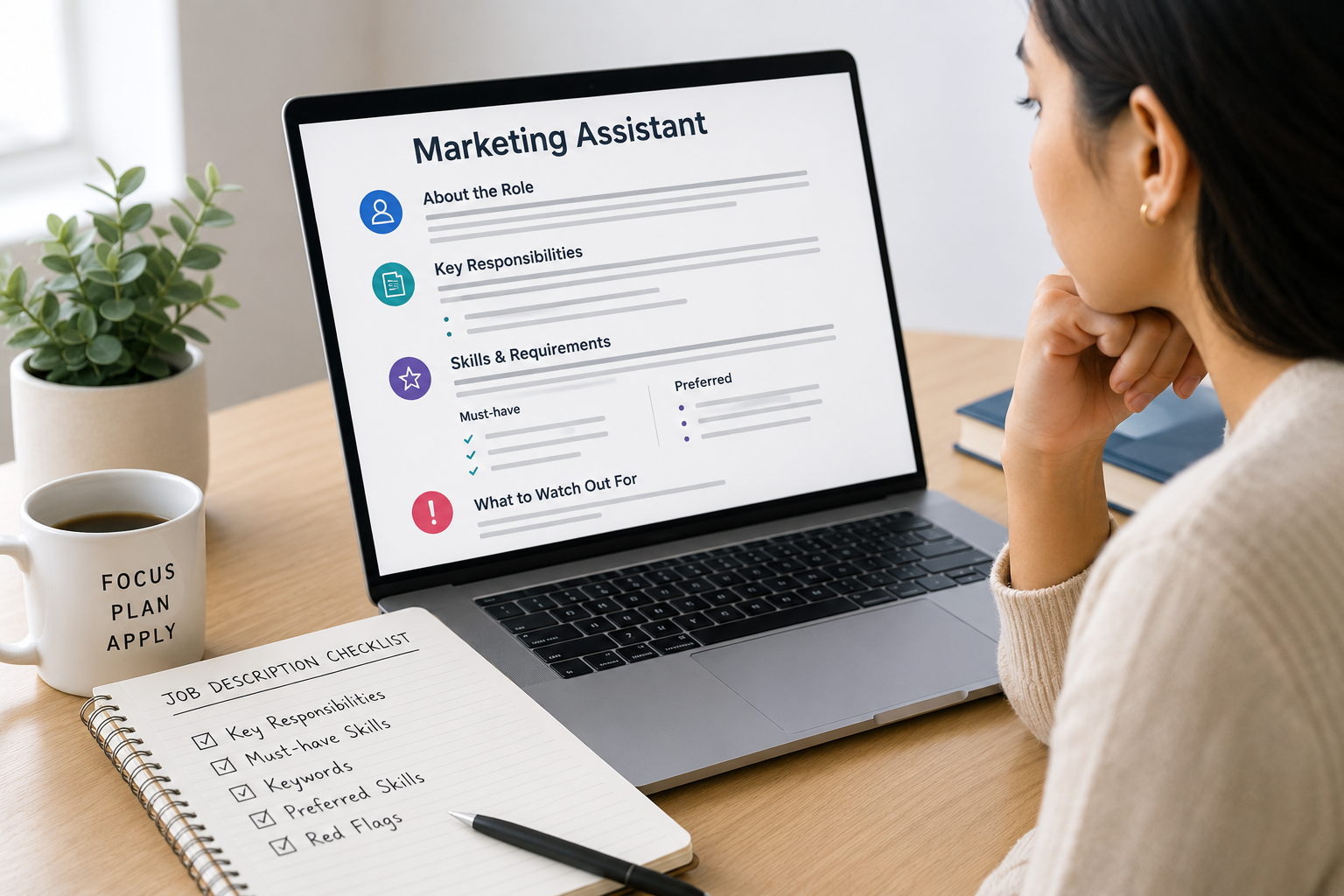
A job title does not always explain the complete role. Two companies may advertise the same position but expect different responsibilities — a Marketing Assistant role at one company may focus mainly on social media, while another may expect the candidate to manage events, customer communication and email campaigns. Reading the full description helps you understand what the role actually involves, what skills the employer values and whether the working hours, location and employment type suit your situation. Students who apply only after reading the job title may miss important details, which can result in unsuitable applications, repeated rejections and wasted time.
Start With the Job Title and Role Summary
The first section of a job advertisement usually includes the job title and a short summary of the position. Don't rely only on the title, because the summary provides the real context. It may explain which department you will work in, who you will report to and whether the role is full-time, part-time, casual or contract. It may also mention whether the work is completed on-site, remotely or through a hybrid arrangement. The role summary can quickly tell you whether the opportunity matches your current experience, availability and career direction.
Understand the Main Responsibilities
The responsibilities section explains what you may be expected to do each day. Employers often list several duties, but the responsibilities placed near the top are usually the most important. A customer service position, for example, may involve responding to enquiries, managing complaints, updating records, processing orders and communicating with other departments. Before applying, compare these responsibilities with your own experience. Your experience does not need to come only from full-time employment — part-time jobs, internships, work placements, volunteer work, university assignments and personal projects can also provide relevant skills, and it's worth learning how to frame transferable experience on your resume (jobreadyplacements.com.au) even when you haven't done the exact same job before.
Essential Requirements Versus Preferred Requirements
Not every requirement in a job advertisement carries the same importance. Essential requirements may include a specific qualification, legal working rights, a professional licence, a valid driver's licence or availability during particular hours — these are usually necessary for the candidate to perform the job legally or safely. Preferred requirements are helpful but not always compulsory, and employers often introduce them using words such as "desirable," "preferred," "ideally," "highly regarded" or "an advantage." You can still apply when you meet the essential requirements but do not match every preferred condition.
Don't Wait Until You Meet Every Requirement
Students and fresh graduates often avoid applying because they don't meet every point listed in the advertisement. However, a job description usually describes the employer's ideal candidate, and the person eventually hired may not meet every requirement perfectly. You should still consider applying when you meet most of the essential criteria, understand the main responsibilities and can provide evidence of transferable skills such as communication, teamwork, organisation, problem-solving and time management developed through education, volunteer work, group assignments or part-time employment. That said, be realistic — missing a compulsory qualification, registration or legal requirement may mean the position isn't suitable for you. The aim is not to apply for every available role, but to focus on jobs where you can genuinely demonstrate value.
Identify Important Resume Keywords
Keywords are the words and phrases employers use to describe the skills, systems and responsibilities required for the job — common examples include customer service, data entry, communication skills, Microsoft Excel, teamwork, time management and attention to detail. These terms matter because employers and Applicant Tracking Systems may scan resumes for relevant keywords. You shouldn't copy complete sentences from the advertisement; instead, include accurate keywords that match your actual experience. Instead of writing "helped customers in a shop," you could write "provided customer service, responded to product enquiries and processed customer transactions" — the second version is clearer, more professional and more closely connected to the employer's requirements.
Match Your Experience With the Employer's Needs
Once you identify the important skills and keywords, compare them with your own experience. If an employer asks for teamwork, you may use an example from a university group project, explaining how you shared responsibilities and completed the work before the deadline. If the role requires organisation skills, you may describe how you managed study, assessments and part-time work at the same time. If communication is important, you can mention presentations, customer service, group discussions or volunteer work. Many students already have useful experience but don't know how to explain it professionally — the key is connecting your background directly to what the employer is asking for, and this is where working through structured career guidance and placement support (jobreadyplacements.com.au) can help turn scattered experience into a focused resume.
Read Experience Requirements Carefully
A job advertisement may ask for one or two years of experience, but this doesn't always mean full-time professional employment. Internships, industry placements, casual jobs, volunteer roles, freelance work and practical coursework may also count as relevant experience. Look for phrases such as "entry-level," "graduate position," "junior role," "trainee," "training provided" or "no experience required," which usually indicate that the employer may consider candidates beginning their careers. However, a senior role requiring several years of specialist or management experience is unlikely to be suitable for a fresh graduate, so apply where your skills and career level reasonably match the position.
Research the Company Before Applying
Before submitting your resume, take some time to research the employer — what the company does, which industry it operates in and what products or services it provides. You should also review its workplace location, values, company size and recent activities to help decide whether the organisation is suitable for you. Company research also helps when writing a cover letter and preparing for an interview, since employers often ask why you want to join their organisation and a generic answer may not be enough. Showing that you understand both the company and the position can make your application more convincing.
Watch for Red Flags in Job Advertisements
Not every job advertisement is genuine. Students and inexperienced job seekers can sometimes be targeted by misleading offers or recruitment scams. Be careful when an advertisement doesn't clearly identify the company, provides no proper role description or promises unrealistic income for very little work. Requests for payment, bank details or sensitive identity documents before a formal interview are also serious warning signs — a legitimate employer should clearly explain the position, work conditions and recruitment process, and you should never have to pay an employer simply to receive a job. Research the company, check its official website and confirm that the contact details are genuine before sharing personal information.
Check Location, Salary and Work Conditions
A role may match your skills but still be unsuitable because of its practical conditions. Check the workplace location, travel time, work schedule, employment type and expected start date, and review whether weekend, evening or shift work is required. If salary information isn't included, research the typical pay range for similar roles in the same industry and location — salary can also be discussed during the recruitment process when appropriate. Confirming these details early can prevent you from applying for a role that doesn't fit your circumstances.
Customise Your Resume Before Applying
Sending the same resume for every job may reduce your chances of being shortlisted. Your resume should highlight the skills and experience most relevant to the position — update your professional summary, include suitable keywords and move your most relevant experience closer to the top. Include clear examples of your responsibilities and achievements rather than vague statements, and focus on what you actually contributed. You don't need to rewrite your entire resume for every application; small changes can make it more relevant and show the employer that you've carefully read the advertisement.
Use the Job Description for Interview Preparation
A job description is also useful after you submit your application, since employers often base interview questions on the skills and responsibilities listed in the advertisement. If the role mentions teamwork, prepare an example of when you worked successfully with others. If it mentions problem-solving, think of a situation where you identified an issue and found a practical solution. You can use the STAR method to organise your answers — explain the situation, describe your task, discuss the action you took and finish with the result. Save a copy of the job advertisement, since it may be removed before your interview date.
Final Thoughts
Reading a job description carefully is one of the simplest ways to improve your job search. It helps you avoid unsuitable roles, understand employer expectations and prepare stronger applications. You don't need to meet every preferred requirement — focus on the essential criteria, transferable skills and evidence you can genuinely provide. A smaller number of targeted applications can be more effective than sending the same resume to dozens of unrelated employers.