Category: Jobseekers, Employers, Interview
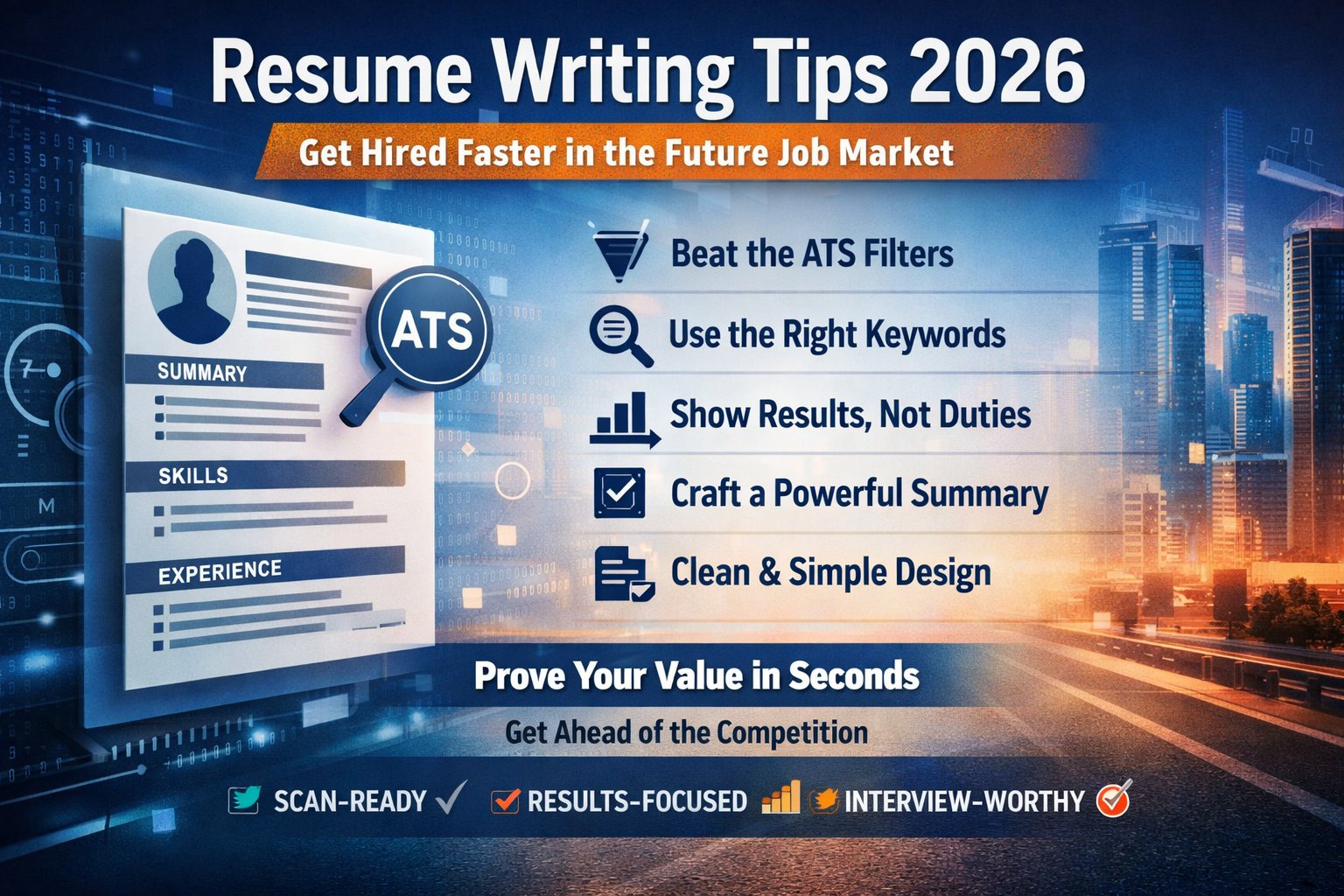
Resume Writing Tips That Will Actually Get You Hired in 2026
Updated for ATS Systems, Recruiter Behavior, and Real Hiring Trends
Your resume is no longer a first impression. It is a filtering system.
Before a recruiter ever sees your profile, your resume is scanned, parsed, and judged by software. If it fails there, it never reaches a human. If it passes, you get a few seconds of attention before a decision is made.
This is not theory. This is how hiring actually works in 2026.
Why Most Resumes Get Rejected
Most candidates lose before the process even starts.
- Recruiters spend around 6 to 8 seconds scanning a resume. That scan is not detailed. It is pattern recognition. Titles, keywords, structure, and proof of results decide everything.
- At the same time, over 70 percent of resumes never reach that stage because Applicant Tracking Systems filter them out due to missing or mismatched keywords.
- Generic resumes make things worse. If your resume looks like it could belong to anyone, recruiters treat it like it belongs to no one.
- Candidates who clearly show measurable achievements consistently outperform those who only list responsibilities.
Conclusion:
If your resume is not optimized for both ATS systems and human scanning, it gets rejected instantly.
Choose the Right Resume Format
There is no universal format, but there is a wrong choice for your situation.
The three standard formats exist for a reason:
- Chronological format works best for candidates with a consistent work history. It shows growth and stability clearly.
- Functional format is useful only when you are hiding something like career gaps or shifting industries. Overuse of this format often raises suspicion.
- Combination format balances skills and experience, making it suitable for mid-level professionals.
For most candidates, especially freshers and early-stage developers, reverse chronological format wins. It is clean, predictable, and aligns with how recruiters scan resumes.
Write a Professional Summary That Proves Value
Your summary is not an introduction. It is a decision trigger.
Most summaries fail because they say nothing specific.
Weak summary:
Passionate individual looking for opportunities
This tells nothing about skills, impact, or direction.
Strong summary:
Backend Developer with 2+ years of experience building scalable APIs using Node.js. Reduced server response time by 35 percent and handled over 10,000 daily requests. Targeting backend roles in product-based companies.
This works because it shows skills, proof, and intent in one block.
Rule:
Clarity, proof, direction. Remove everything else.
Use Keywords Like a System, Not a Guess
ATS systems do not understand potential. They match text.
If your resume does not contain the exact keywords from the job description, it will not rank.
The correct method is simple:
- Start with the job description. Extract required skills, tools, and technologies. Then integrate those exact terms naturally into your resume.
- If the job requires React, Node.js, and MongoDB, those exact terms must appear in your resume. Writing “web development experience” instead is useless.
- Precision beats creativity here.
Show Results Instead of Responsibilities
This is where most resumes collapse.
Listing responsibilities does not prove competence. It only proves participation.
Weak statement:
Managed a team of developers
Strong statement:
Led a team of 5 developers to deliver a project 2 weeks ahead of schedule, improving client satisfaction score by 30 percent
The difference is measurable impact.
Formula to follow:
Action + Numbers + Outcome
If there are no numbers, your claim is weak.
Build a Skills Section That Matches the Job
Random skill dumping is a common mistake.
Recruiters are not impressed by long lists. They are looking for relevance.
A structured skills section works better:
Languages: JavaScript, Python
Frontend: React.js, Next.js
Backend: Node.js, Express.js
Database: MongoDB, PostgreSQL
Tools: Git, Docker
Every skill listed should align with the job you are targeting. If it does not help you get that role, remove it.
Design for ATS Compatibility
- Creative resumes look good but fail technically.
- Most ATS systems struggle with complex layouts.
- Avoid multi-column designs, tables, icons, and graphics. These elements break parsing and reduce your chances of getting shortlisted.
- Use a single-column layout with clear headings, standard fonts, and consistent spacing.
- Your resume is not a design project. It is a structured data document.
Proofread Like a Recruiter Looking for Reasons to Reject
Recruiters are not looking for reasons to select you. They are looking for reasons to reject you quickly.
One spelling mistake or formatting inconsistency signals carelessness.
The correct process is simple:
- Run your resume through a grammar tool. Read it line by line manually. Then get a second review from someone who understands hiring standards.
- Zero errors is not a bonus. It is the minimum requirement.
What Recruiters Actually Look For
Recruiters do not read resumes. They scan for signals.
They are trying to answer four questions instantly:
Is the job title relevant
Do the skills match
Are there measurable results
Is the format clean and easy to scan
If these answers are not visible within seconds, your resume is skipped.
Internal Optimization Strategy for Your Blog
- If you are publishing this article, structure it for both users and search engines.
- Link this article to related content like interview preparation guides, in-demand skills, and job listings pages.
- This increases session time, improves SEO performance, and moves readers toward action instead of just consumption.
Final Takeaway
- A resume is not about you. It is about how clearly and quickly you prove value.
- If your resume is generic, unfocused, or poorly structured, it will fail silently.
- If it is precise, results-driven, and aligned with job requirements, it will get you interviews.
- There is no middle ground.
Sources
#ResumeTips2026 #ATSResume #JobSearchStrategy #ResumeWriting #CareerGrowth #JobSeekers #TechCareers #HiringTrends #FreshersJobs #ResumeOptimization #CareerAdvice #InterviewPreparation #LinkedInTips #JobHunt2026 #ProfessionalGrowth