Category: Jobseekers, Employers, General
How Multinational Companies Are Redesigning Graduate Jobs for the AI Era
Published by: Isabelle Moore | 26 August 2026
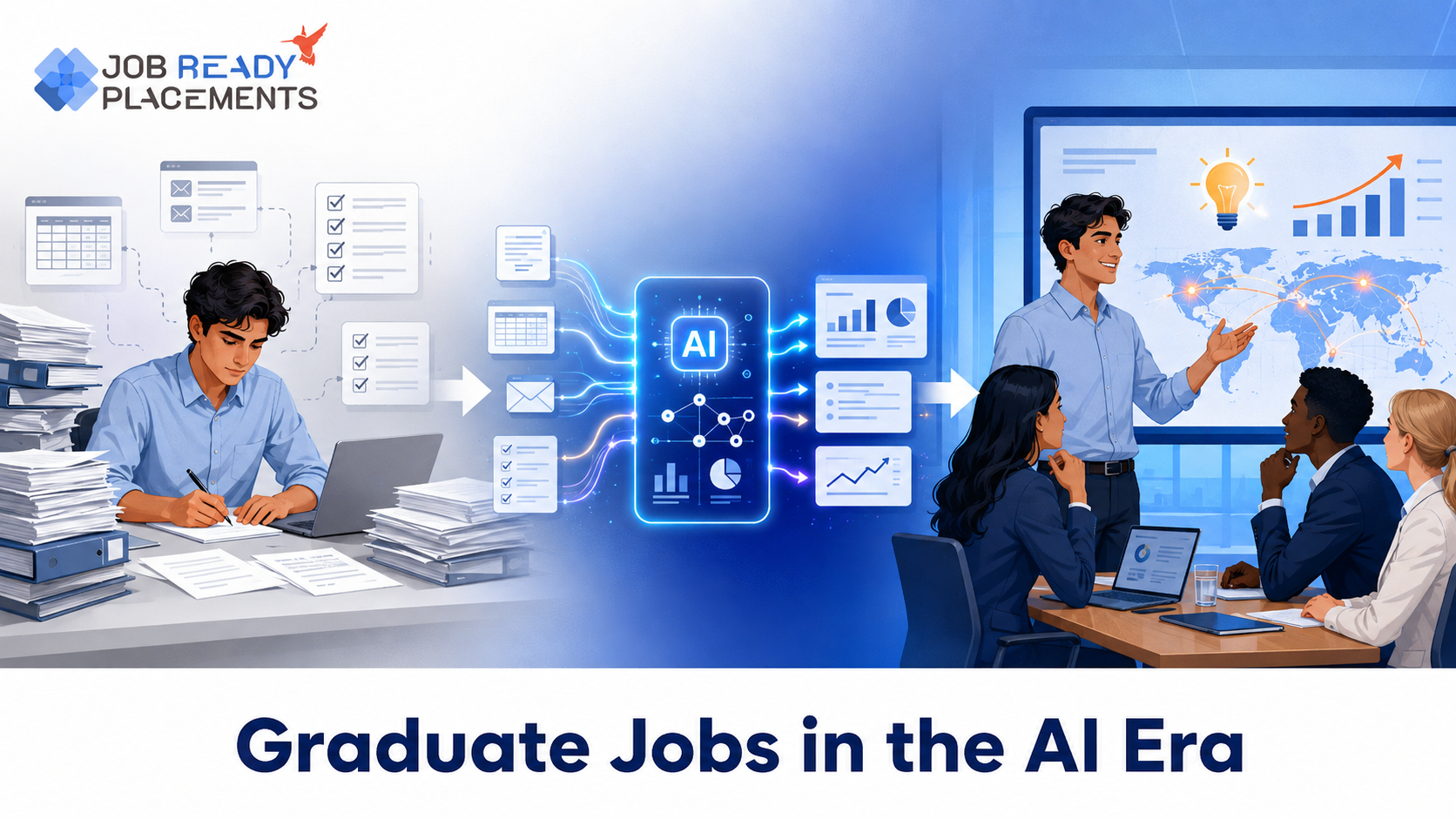
Artificial intelligence is changing how multinational companies recruit, train and develop graduates. Employers are redesigning graduate roles so employees can use AI while contributing creativity, communication, judgement and accountability that technology cannot provide independently.
Routine activities such as summarising documents, organising information, preparing research and creating first drafts can now be supported by AI. As this work becomes faster, graduates may receive responsibilities earlier. For Australian students and recent graduates, job readiness now requires a qualification, digital confidence, critical thinking, professional communication and an understanding of when human judgement must lead.
1. Why Graduate Jobs Are Changing
Graduate roles have traditionally allowed employees to learn through straightforward assignments before progressing to complex responsibilities. A junior employee might spend months preparing spreadsheets, conducting basic research, organising files or producing standard reports. AI can now support many of these activities by reviewing information, identifying patterns, producing summaries and suggesting possible solutions.
AI reduces time spent on repetitive work, but it does not remove the need for graduates. It may provide inaccurate, incomplete or biased information because it cannot fully understand every business objective, customer expectation or workplace risk. Employers therefore need graduates who can check its work, recognise missing context and make informed decisions.
2. AI Is Becoming Part of Everyday Graduate Work
AI is no longer limited to software engineering and data science. It is being introduced across marketing, finance, consulting, human resources, customer service, law, project management and supply-chain operations.
A marketing graduate may use AI to organise customer feedback before deciding which insights deserve attention. A finance graduate could use automated systems to classify transactions while personally investigating unusual results. A human resources graduate might use AI to summarise an employee survey but remain responsible for protecting privacy and identifying possible bias.
Similarly, a consulting graduate may use AI to prepare initial research. The graduate must still verify important facts, understand the client’s circumstances and develop a practical recommendation. Basic AI literacy is therefore becoming a general workplace capability rather than a specialist skill required only in technical careers.
3. Work Is Becoming More Outcome-Focused
Before widespread AI adoption, productivity was often measured by how many tasks an employee completed. In an AI-supported workplace, employers are paying greater attention to the quality and outcome of the work.
Before relying on an AI-generated result, graduates should ask:
- Is the available information reliable and complete?
- Does the output answer the actual business question?
- Has important customer or workplace context been overlooked?
- Could the recommendation create ethical, legal or commercial risks?
- What action should the organisation take next?
For example, an AI platform might summarise hundreds of customer complaints. Simply copying that summary into a presentation would add limited professional value. A capable graduate would compare it with the original information, identify recurring concerns, investigate unusual patterns and recommend realistic improvements. AI can accelerate the analysis, but the graduate must transform that analysis into a useful business outcome.
4. Human Skills Are Becoming More Valuable
Graduates may assume technical knowledge will become the only factor that matters. In reality, multinational companies need employees who can combine digital confidence with strong human capabilities.
Global organisations operate across different countries, departments, cultures and time zones. Graduates may need to explain technical information to a client, collaborate with international colleagues or present recommendations to senior managers.
The most valuable capabilities include:
- Analytical thinking and problem-solving
- Clear written and verbal communication
- Creativity and professional curiosity
- Teamwork and cross-cultural collaboration
- Adaptability and continuous learning
- Ethical judgement and active listening
AI can generate a professional-looking response, but it cannot accept responsibility for determining whether that response is suitable for a particular organisation or customer. Graduates who can question unreliable information, communicate with different audiences and build trust with colleagues will remain valuable as technology develops.
5. Responsible AI Use Is Essential
Knowing how to write an effective prompt does not automatically make someone professionally AI-ready. Graduates must understand when AI should be used and when it could create serious risks.
Employees should never enter confidential customer details, private employee data, unpublished financial information or protected company material into an unauthorised AI platform. Other risks include invented information, biased recommendations, privacy breaches, copyright problems, outdated results and excessive dependence on automated answers.
Before using AI, graduates should confirm that the tool is approved, protect confidential information and verify important results through reliable evidence. Employees remain responsible for submitted work, even when technology assisted them. Responsible use therefore involves checking facts, protecting sensitive data and explaining how AI contributed to the final result.
6. Recruitment Is Becoming More Skills-Based
AI is changing graduate roles and the methods companies use to select candidates. Employers may use automated resume screening, online assessments, recorded interviews and digital work simulations. Adding popular AI keywords to a resume will not guarantee success because every claimed skill should be supported by evidence.
Instead of writing “proficient in generative AI,” a candidate could explain that they used an AI platform to organise customer feedback, verified the themes against the original data and presented practical recommendations.
Evidence does not need to come only from professional employment. Graduates can use examples from university assignments, internships, volunteering, student societies, virtual experience, part-time work and personal projects. Employers want to understand the problem addressed, how technology supported the work, what the candidate personally contributed and what outcome was achieved.
7. How Graduates Can Prepare
Graduates do not need a large collection of complicated technical projects. Two or three clearly explained examples can demonstrate practical ability. Suitable projects might include analysing a public dataset, improving a fictional customer-service process, creating an AI-supported marketing campaign or comparing AI-generated research with authoritative sources.
Present every portfolio project using five clear points:
- The original problem you wanted to solve
- The AI tools and reliable information you used
- The accuracy and privacy checks you completed
- The decisions and improvements you made personally
- The final outcome, limitations and lessons learned
This structure demonstrates that you understand AI as a professional tool rather than a shortcut. It also provides credible evidence for applications and interviews.
During an interview, be prepared to explain how you would verify an AI-generated answer, protect confidential information and respond to a biased recommendation. Use genuine examples and clearly separate your contribution from the technology’s contribution. Employers need to understand your judgement and learning process.
8. Final Thoughts
Multinational companies are not simply eliminating graduate jobs because of artificial intelligence. They are redesigning entry-level employment around effective collaboration between people and technology. Some repetitive activities will become faster, while problem-solving, communication, verification and ethical judgement become increasingly valuable.
Graduates who use AI responsibly and connect technology with genuine business needs will be better prepared for global careers. You do not need advanced programming skills. Start by building digital confidence, completing one credible project and learning to explain your decisions clearly.
In the AI era, the strongest graduate will not be the person who allows technology to complete everything. It will be the person who knows how to use technology thoughtfully, question its results and recognise when human judgement must lead.
Sources and References
1. Jobs and Skills Australia – Our Gen AI Transition
https://www.jobsandskills.gov.au/publications/generative-ai-capacity-study-report
Australian research explaining how generative AI is changing workplace tasks, skills and employment.
2. Jobs and Skills Australia – Jobs and Skills Report 2025
https://www.jobsandskills.gov.au/publications/jobs-and-skills-report-2025
Examines changing skill requirements, digital literacy and the importance of human capabilities.
3. Microsoft – Recent Graduate Opportunities
https://careers.microsoft.com/v2/global/en/recentgraduate
Provides information about Microsoft’s current graduate pathways and AI-supported workplace expectations.
4. Accenture Australia – Graduate Careers
https://www.accenture.com/au-en/careers/local/graduate-careers
Covers graduate opportunities, structured learning, real projects and technology-focused career development.
5. Deloitte Australia – Graduate Program
https://www.deloitte.com/au/en/careers/students/graduate-program-careers.html
Explains Deloitte’s graduate learning, coaching and hands-on professional development opportunities.
6. OECD – AI and Skills
https://www.oecd.org/en/publications/ai-and-skills_f843b352-en/full-report.html
Explores the digital, data, cognitive and human skills employees need in AI-supported workplaces