Category: Jobseekers, Employers, Interview
How Multinational Companies Are Changing Entry-Level Careers for Students and Job Seekers
By Charlotte Evans | 15 June 2026 | 10:00 AM IST
Multinational companies are changing the way entry-level careers begin in Australia and around the world. For many years, students and fresh graduates believed that a degree, a basic resume, and a few job applications were enough to start a career with a global company. That idea is now changing fast.
Today, large multinational companies are not only looking for people who have studied well. They want people who can work well, learn fast, use technology confidently, communicate clearly, and solve real workplace problems. Entry-level jobs still exist, but the expectations attached to them are rising.
This shift matters for Australian students, fresh graduates, job seekers, training providers, and employers. It shows that career success now depends on job readiness — not only academic achievement.
Why Entry-Level Jobs Are Changing in 2026
Multinational companies operate across countries, time zones, cultures, and digital systems. Their teams are spread across different markets, and their work is becoming increasingly technology-driven. Because of this, companies want new employees who can adjust quickly and contribute from day one.
Artificial intelligence, automation, cloud platforms, cybersecurity, data tools, and digital collaboration systems are changing how work is done. Many routine tasks that were once handed to junior employees are now being supported or handled by technology.
Reuters recently reported that global companies operating Global Capability Centres in India are rethinking their hiring strategies because AI and automation are changing the skills required for day-to-day work. Traditional entry-level roles are declining in some areas as companies become more selective and prioritise practical AI, cybersecurity, and digital skills.
This does not mean students have no opportunities. It means the entry point is changing. Companies still need young talent — but they want young talent that is prepared for real workplace demands.
Degrees Still Matter, But Skills Matter More
A degree can help students enter the job market, but it is no longer enough on its own. Multinational companies increasingly want evidence that a candidate can apply knowledge in real situations.
For example:
- A business graduate may be expected to understand basic data analysis, customer communication, CRM tools, and workplace reporting
- An IT graduate may be expected to understand cloud platforms, AI tools, cybersecurity basics, and project collaboration
- A marketing graduate may need digital campaign knowledge, content skills, analytics understanding, and AI-assisted productivity
ManpowerGroup's 2026 Global Talent Shortage report found that more than seven in ten employers were still struggling to find the talent they need. The problem is not always a lack of applicants — the bigger issue is a lack of candidates with the right skill match.
For Australian students and job seekers, this is an important lesson: getting hired is not only about applying for more jobs. It is about becoming the kind of candidate employers can trust with real work.
How AI Is Changing the First Step of a Career
AI is one of the biggest reasons entry-level careers are changing. In the past, junior employees often started with simple tasks such as basic research, data entry, documentation, reporting, scheduling, or first-level support. Many of these tasks can now be completed faster using AI tools.
This does not remove the need for people. Instead, it changes what people are expected to do. Entry-level employees may now need to check AI outputs, improve workflows, communicate insights, support teams, and use digital tools responsibly.
TCS recently announced a global partnership with Anthropic and said it will equip 50,000 associates across engineering, finance, legal, marketing, and sales with Claude through enterprise-wide licensing. This shows how major multinational companies are preparing employees across all departments — not just technical teams — to work with AI tools.
For Australian students, the message is clear: AI knowledge is no longer only for software engineers. It is becoming essential in business, administration, marketing, finance, customer service, operations, and many other career paths.
Multinational Companies Want Work-Ready Graduates
Entry-level candidates often struggle because they understand theory but lack workplace confidence. Multinational companies want employees who can communicate professionally, follow instructions, manage deadlines, ask the right questions, and work in teams.
This is where practical training, internships, work placements, and project-based learning become very important. These experiences help students understand how workplaces actually operate.
A student who has completed a real project, used workplace tools, handled feedback, attended mock interviews, or worked within a team may have a strong advantage over someone who only has academic marks.
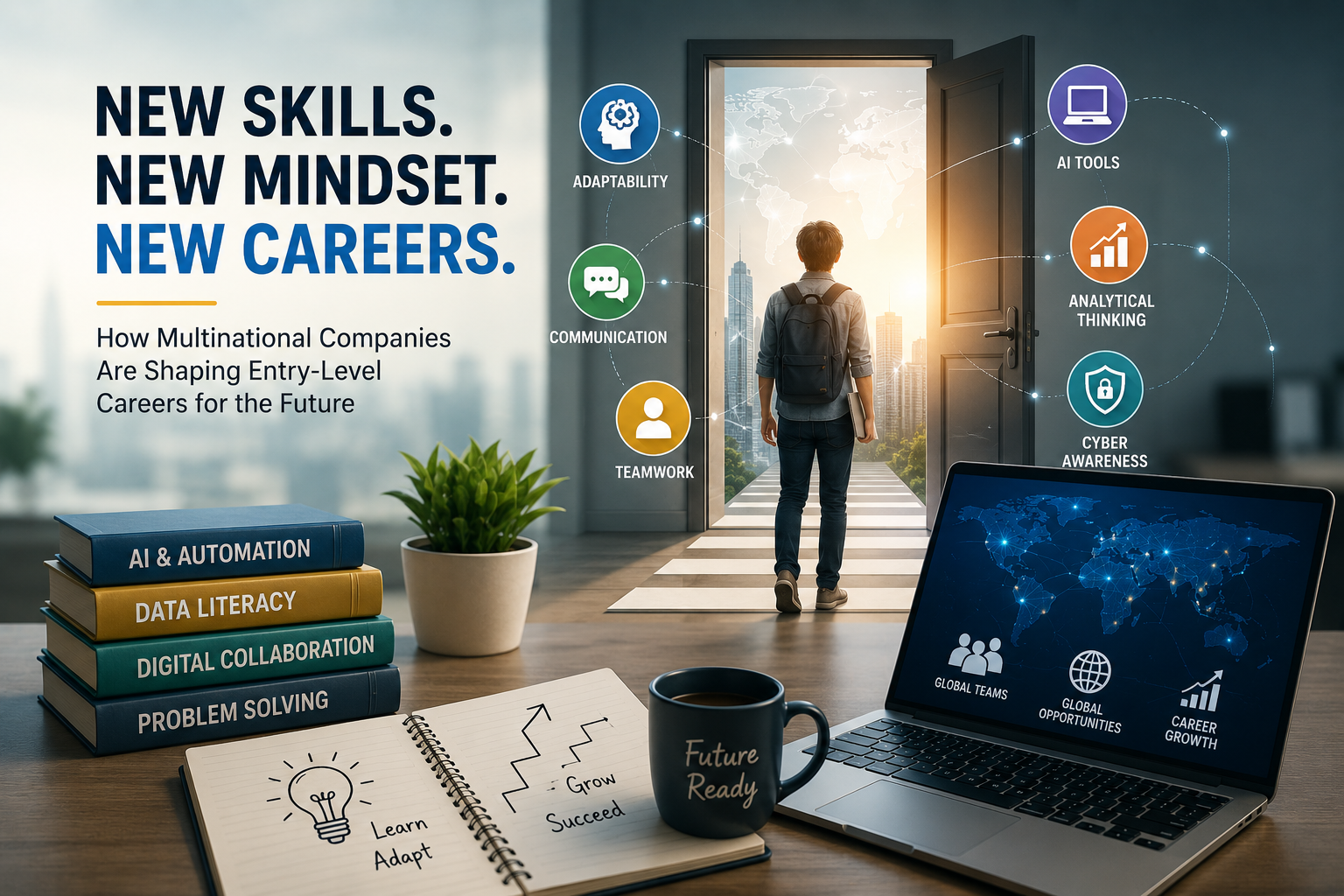
Job-ready confidence includes:
- Clear written and verbal communication
- Basic digital and AI tool skills
- Problem-solving ability in real situations
- Teamwork and collaboration
- Time management and deadline awareness
- Professional workplace behaviour
- Willingness to learn and adapt
These skills may sound simple, but they are often the difference between being shortlisted and being rejected.
The Rise of Skills-Based Hiring in Australia
Another major change is skills-based hiring. Many multinational companies are moving beyond checking degrees and job titles alone. They want to know what a person can actually do.
This is why resumes now need to show practical skills, tools, projects, internships, certifications, and measurable achievements. A resume that only lists education may look weak next to a resume that shows real workplace preparation.
Instead of writing only:
"Completed Bachelor of Business"
A stronger candidate shows:
Customer research experience, Excel reporting, CRM tools, presentation work, team collaboration, and internship projects.
Instead of writing only:
"Studied Information Technology"
A stronger candidate shows:
Knowledge of Python, cloud basics, cybersecurity awareness, GitHub projects, AI tools, or helpdesk support experience.
The goal is not to show perfection. The goal is to show readiness.
Global Companies Are Investing in Skills Training
Large companies are investing more in training because skill gaps are directly affecting their ability to hire. Google recently announced a $50 million initiative through Google.org to help train 300,000 skilled trade workers in the United States — supporting roles connected to digital and AI infrastructure including electricians, welders, plumbers, pipefitters, manufacturing workers, and fibre technicians.
This matters because it shows the future of work is not only about coding. AI growth also depends on infrastructure, technical trades, operations, maintenance, logistics, and human skills.
For Australian students, this is an important signal. Global career opportunities are becoming wider but also more skills-focused. Whether someone is pursuing IT, business, trades, healthcare, administration, logistics, marketing, or customer service — practical skills are becoming more valuable than ever.
What Australian Students and Graduates Should Do Now
Students and fresh graduates should not wait until graduation to become job ready. Career preparation should start as early as possible.
Here are practical steps to take right now:
- Research the roles you want — study job descriptions and identify the skills employers repeatedly ask for
- Build a skills-based resume — go beyond listing degrees; show tools, projects, and experience
- Improve your LinkedIn profile — recruiters from multinational companies actively search LinkedIn
- Practise interviews — use mock interviews to build confidence before the real thing
- Gain real experience — internships, volunteer work, and placements all count
- Learn to use AI tools responsibly — not to replace your thinking, but to improve your productivity and research
Even small experiences can make a big difference when presented correctly.
Common Mistakes Job Seekers Must Avoid
Many job seekers make the mistake of applying to hundreds of roles with the same generic resume. Multinational companies receive large volumes of applications, so generic submissions are easy to reject.
Job seekers should avoid:
- Sending the same resume to every employer
- Ignoring specific skill requirements listed in job ads
- Applying without researching the company
- Using a weak or vague career summary
- Listing duties instead of achievements
- Relying only on a degree with no practical evidence
- Skipping internships or work experience
- Failing to prepare for interviews
A better approach is to target fewer roles and prepare stronger, more tailored applications.
What Employers Should Understand
Employers also have a role to play. If companies want job-ready candidates, they need to support clearer pathways between education and employment.
This includes structured internships, entry-level training programs, mentorship, realistic job descriptions, and early-career development opportunities. Many students have strong potential but need the right exposure to understand professional expectations.
When employers invest in training early-career talent, they build stronger teams and reduce long-term skill shortages across Australia.
Why Job Readiness Is the New Career Advantage
The future of entry-level careers will belong to candidates who combine education with practical ability. Multinational companies are no longer only asking, "What did you study?" They are asking, "What can you do with what you studied?"
This is why job readiness has become the most important career advantage for students and graduates in 2026. It helps candidates move from classroom knowledge to real workplace performance. It helps employers find better-prepared talent.
For students and fresh graduates in Australia, the message is clear: do not wait for the job market to become easier. Become more prepared for the job market that already exists.
Conclusion
Multinational companies are reshaping entry-level careers because the world of work is changing. AI, automation, global teams, digital tools, and skills shortages are redefining what employers expect from new talent in Australia and internationally.
A degree can still open the door — but practical skills, workplace confidence, and adaptability are what help candidates walk through it.
For students and job seekers, this is the right time to focus on job readiness. Learn the tools, build the skills, gain experience, improve your resume, and prepare for interviews with a clear career direction.
The entry-level career path is not disappearing. It is becoming smarter, more competitive, and more skills-driven. Candidates who prepare early will have the strongest chance to succeed.
#MultinationalCompanies #EntryLevelCareers #Students #JobSeekers #JobReadySkills #GraduateCareers #FreshGraduateJobs #SkillsBasedHiring #AIHiring #CareerPreparation #WorkplaceReadiness #DigitalSkills #PracticalTraining #Internships