Category: Jobseekers, General
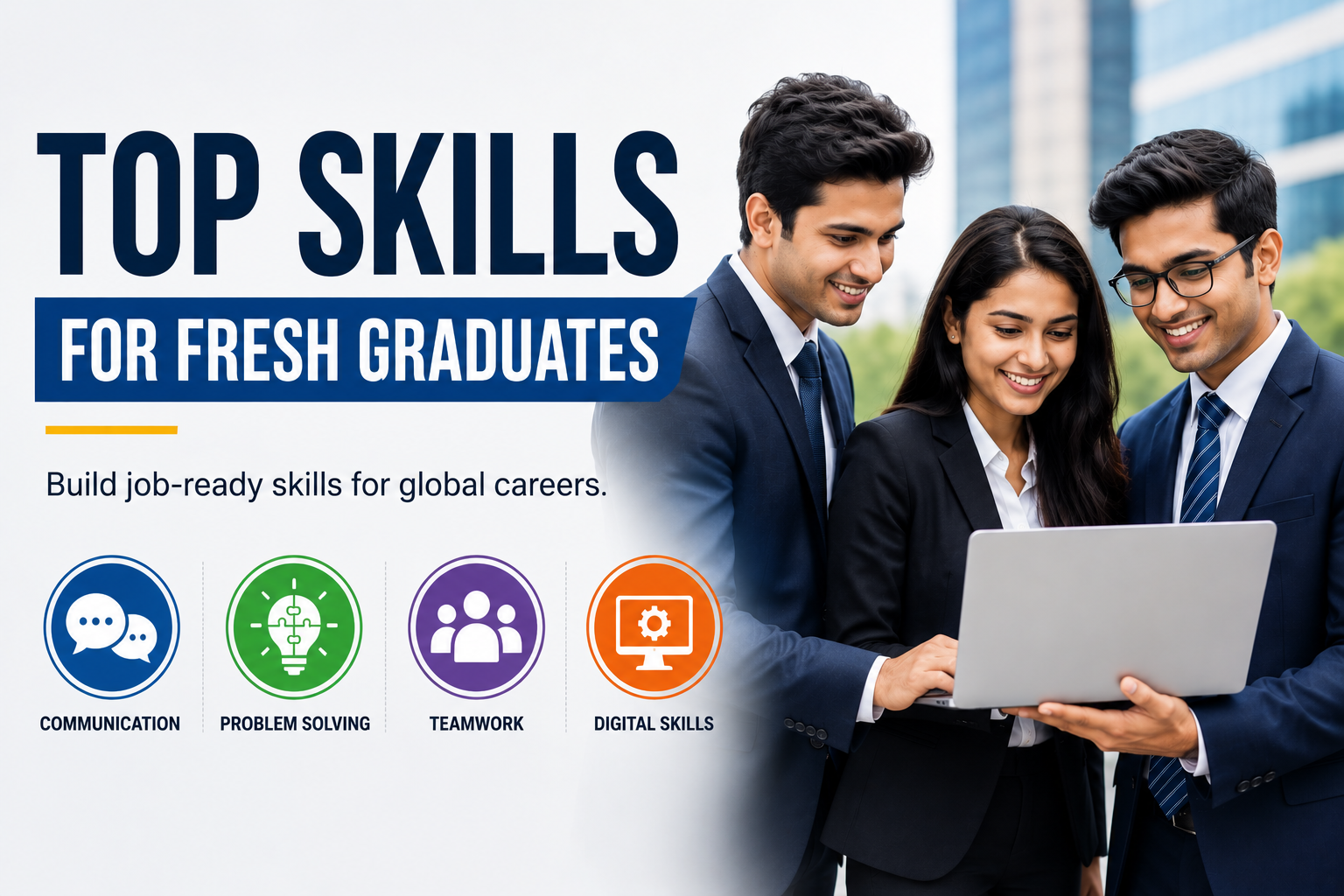
Top Skills Multinational Companies Look for in Fresh Graduates
Published By Sophie Carter | 25 June 2026 | 10:35 AM IST
Two students walk out of the same college with the same degree and almost identical marks. Six months later, one is working at a multinational firm and the other is still sending applications.
The difference is rarely the degree itself. It's almost always the skills that don't show up on a transcript — how they spoke in the interview, how they handled a tricky question, whether they seemed ready to actually work.
Recruiters at large companies read hundreds of resumes that look the same on paper. So they stop relying on grades to separate candidates and start looking for specific signals instead.
Here's what those signals actually are, and how a student can build them before graduation rather than after.
Why Degrees Alone Stopped Being Enough
A few years ago, a good degree from a known college was often enough to get shortlisted. That's changed. More students now hold similar qualifications than ever before, which means the degree gets someone into the applicant pool — it doesn't get them out of it.
What separates candidates inside that pool is almost always behavioural, not academic. Recruiters have noticed this shift too, which is why so many interview processes now include group discussions, situational questions, and short tasks instead of just a straightforward Q&A about the syllabus.
Communication That Holds Up Under Pressure
Most graduates can talk normally in a casual chat. Far fewer can explain a project clearly to someone who's never heard of it, or answer a question they weren't expecting without going silent for ten seconds.
This is what recruiters are actually testing in an interview — not vocabulary, but composure. Can the candidate organise a thought on the spot? Can they answer "tell me about a time you failed" without either freezing or rambling for five minutes?
Group discussions are designed specifically to catch this. A one-on-one interview can be rehearsed. A live discussion with five strangers can't.
Email and Written Communication Matter Too
This part gets far less attention but counts just as much. A fresher who writes a clear, short email gets faster replies and looks more professional than one who sends long, unstructured messages that bury the actual question somewhere in the middle.
The same applies to how a resume reads, how a cover letter is worded, and even how someone replies to a recruiter's message before the interview has even started.
Solving Problems Without Being Told the Steps
Classroom problems usually come with a method already attached — apply this formula, follow this process. Workplace problems rarely do. A new joiner might be told "our delivery times have gone up this month, look into why" with no further instructions.
This is why recruiters lean on case-study style questions during interviews — not to check if the candidate knows the "right" answer, but to see how they break down a vague problem into smaller, testable pieces.
Students who've done even one real internship usually handle this better than someone who's only studied theory, simply because they've already had to figure something out without a textbook nearby.
What Recruiters Are Actually Watching For
The detail that stands out most is the questions a candidate asks before attempting an answer. Someone who asks "what data do we already have on this?" before jumping to a solution looks far more prepared than someone who guesses immediately. That instinct to gather information first is exactly what's needed once the job starts.
Picking Up New Tools Without Panic
Every company runs on a slightly different stack of tools — its own CRM, its own reporting dashboard, its own internal chat system. No company expects a fresher to know their specific software on day one.
What they're checking for is whether someone freezes up when handed something unfamiliar, or just starts clicking around and figures it out.
A graduate who's comfortable in spreadsheets, has used at least one project management tool, and isn't intimidated by AI tools like ChatGPT or Copilot for drafting and research, adjusts noticeably faster in the first month than someone who's only ever used what was taught in class.
Small Details That Reveal Digital Comfort
This comfort with tools shows up in smaller ways too — how someone formats a resume, whether they've built even a basic LinkedIn profile, or how they handle a quick technical test sent through email. These are minor details on their own, but recruiters notice them because they hint at how someone will function once real systems are involved.
Handling Disagreement Without Going Quiet or Going Rigid
Teamwork sounds like a soft, fluffy skill until you're actually in a group where two people disagree on the approach and a deadline is two days away. That's the real test — not whether someone is "friendly," but whether they can push back on an idea respectfully, or accept being overruled without sulking through the rest of the project.
Recruiters notice this in how a candidate talks about past group work. "We all worked well together" tells them nothing. "One teammate wanted to go a different direction, here's how we resolved it" tells them a lot more about how someone will behave once they're on a real team with real stakes.
Managing Deadlines Without Constant Reminders
In college, deadlines are managed for you — professors remind you, extensions exist, the whole structure is built around catching up. In a job, nobody is going to chase a fresher about a pending task more than once or twice before it starts affecting how they're seen.
The students who handle this well aren't necessarily the most disciplined people in the room. They're usually the ones who've already had to juggle something real — a part-time job alongside classes, an internship with actual deadlines, or organising a college event with a fixed date that couldn't move.
That experience of "this has to be done by Friday, no extensions" is hard to fake in an interview, but it's easy to spot when it's genuine.
Staying Steady When Feedback Is Blunt
Workplace feedback isn't always wrapped in encouragement the way college feedback often is. A manager might just say "this isn't right, redo it" with no further explanation.
Graduates who take this personally or get visibly defensive struggle in their first few months, regardless of how skilled they are otherwise. The ones who do well have usually learned to separate criticism of the work from criticism of themselves.
How Recruiters Test This in Interviews
Some interviewers deliberately give slightly sharp or unexpected feedback mid-conversation, just to see how a candidate reacts in the moment — whether they get defensive, go quiet, or take it in stride and respond calmly.
Showing Initiative Without Waiting for Permission
This doesn't mean trying to lead every project as a fresher. It means flagging a problem before being asked, offering to help a struggling teammate, or asking a clarifying question instead of guessing and getting it wrong.
Companies remember which fresher did this in their first month, because it's rare. Most new joiners stay quiet and wait to be told exactly what to do, which is safe but doesn't get noticed.
Cultural Awareness in Global Teams
Multinational companies often mean working with colleagues across different countries, time zones, and communication styles. Something as simple as how directly feedback is given, or how formal an email should sound, can vary a lot between teams based in different regions.
Graduates who show even basic awareness of this — for example, understanding that a blunt tone that's normal in one culture might come across as rude in another — tend to settle into global teams faster than those who assume everyone communicates the same way.
What Students Can Actually Do About This Before Graduation
None of this requires a certification course. A part-time job, one solid internship, organising even a small college event, or working on a group project that didn't go smoothly and had to be sorted out — these build all the above far faster than any workshop does.
The one thing that makes a real difference at interview stage is being able to talk about these experiences with specific detail instead of vague claims.
"I'm a team player" convinces no one. "Here's a time a teammate dropped out two days before a submission and what I did about it" usually does.
The students who get shortlisted aren't always the most qualified on paper. They're the ones who can prove, with one good story, that they've already handled something close to what the job will actually demand.
Conclusion
None of these skills show up on a degree certificate, which is exactly why they end up deciding who gets hired when two candidates look identical on paper.
The good news is none of them require special access or money to build — just a willingness to take on something real before graduation, even if it's small, and pay attention to how you handled it.
Sources and References
World Economic Forum — Future of Jobs Report 2025
https://www.weforum.org/publications/the-future-of-jobs-report-2025/
NACE — What Employers Look for on Student Resumes
https://www.naceweb.org/talent-acquisition/candidate-selection/what-are-employers-looking-for-when-reviewing-college-students-resumes
LinkedIn Learning — Workplace Learning Report 2025
https://business.linkedin.com/learn/resources/workplace-learning-report
Microsoft — 2025 Work Trend Index
https://news.microsoft.com/annual-work-trend-index-2025/
Coursera — Job Skills Report 2025
https://assets.ctfassets.net/2pudprfttvy6/5hucYCFs2oKtLHEqGGweZa/cf02ebfc138e4a3f7e54f78d36fc1eef/Job-Skills-Report-2025.pdf
OECD — Skills Outlook 2025
https://www.oecd.org/en/publications/2025/12/oecd-skills-outlook-2025_ac37c7d4.html
McKinsey — Future of Work Insights
https://www.mckinsey.com/featured-insights/future-of-work
#FreshGraduates #JobReadySkills #MultinationalCompanies #MNCJobs #CampusPlacements #GraduateJobs #CareerTips #InterviewSkills #EmployabilitySkills #DigitalSkills #FresherJobs #PlacementPreparation