Category: Jobseekers, Employers, Interview
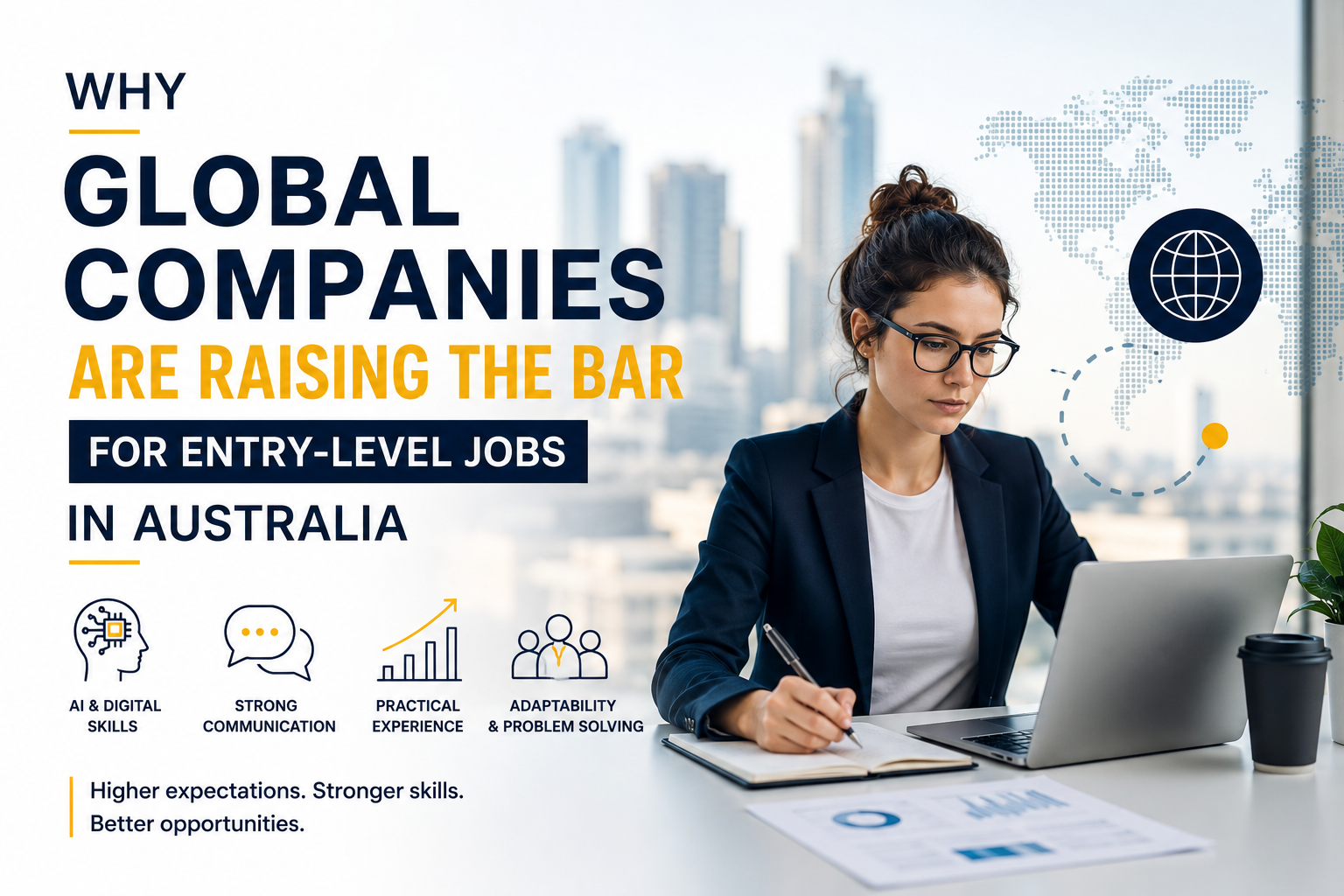
Why Global Companies Are Raising the Bar for Entry-Level Jobs in Australia
By Hannah Brooks | 18 June 2026
If you have applied for a graduate role at a multinational recently and felt the expectations were higher than before, you are not wrong.
Entry-level hiring in Australia is changing. The first job is no longer seen as a training role where companies teach everything from scratch. Global employers now expect students and fresh graduates to arrive with stronger digital confidence, better communication, practical exposure, and the ability to adapt quickly.
This does not mean graduate opportunities have disappeared. It means the competition has changed. The candidates who stand out today are not always the ones with the best degree. They are the ones who can show they are ready for real workplace situations — from day one.
For students and fresh graduates, understanding this shift is important. It can help you prepare smarter, apply better, and improve your chances of securing a role at a multinational company in Australia.
The Graduate Job Market Is Still Active, But More Selective
Australia's graduate job market has shown signs of stability after a softer period. Graduate postings remain above pre-pandemic levels in most parts of the country — which means opportunities are still there for students and recent graduates who know how to find them.
However, the nature of those opportunities has changed.
Many employers are no longer hiring fresh graduates only for simple support tasks. They want candidates who can navigate workplace tools, work with data, use technology responsibly, and communicate clearly with teams and managers.
A role may still be labelled entry-level, but the expectations inside that role can now feel closer to what earlier graduates only picked up after several months on the job.
There are still jobs. The standard for getting them has simply become higher.
Why Entry-Level Roles Are Changing
The biggest driver of this change is automation.
AI and digital tools are now helping companies complete many basic tasks faster than before. Work such as simple research, draft writing, formatting, data entry, and reporting support can now be handled by technology — tasks that were previously handed to junior employees.
This means graduates are being expected to focus on work that requires thinking, judgment, and communication. Employers want candidates who can use tools properly, understand context, and make sensible decisions — not just complete checklists.
This shift creates both pressure and opportunity.
The pressure is real: fresh graduates must be more prepared than before.
The opportunity is equally real: students who combine modern tools with strong human skills can stand out quickly and progress faster than previous generations of graduates.
AI Literacy Is Becoming a Basic Career Skill
For many global companies, AI awareness is no longer a bonus skill. It is becoming part of everyday workplace readiness.
This does not mean every student needs to become a developer or AI specialist. But candidates should understand how AI tools can support research, writing, planning, analysis, and productivity — and be able to use them confidently in practice.
- A business graduate can use AI to organise research and prepare clear summaries
- A marketing student can use AI to plan campaign ideas and analyse audience data
- A finance student can use AI-assisted tools to understand data patterns and reporting formats
- An IT student can use AI to support coding, testing, and documentation
But using AI is not enough on its own. Employers also want candidates who can check accuracy, protect confidential information, and improve output with human judgment.
Research shows that 61% of Australian hiring managers say they will pass on candidates who lack AI experience. At the same time, a graduate who uses AI responsibly and critically will always look stronger than someone who simply copies AI-generated answers without review.
Degrees Still Matter, But They Are No Longer Enough
A degree is still valuable. It shows a candidate has completed formal education and built academic knowledge. But for many global employers, a degree is now only the starting point — not the differentiator.
Companies want to know whether a candidate can apply that knowledge in a practical setting.
This is why internships, live projects, volunteering, part-time work, and portfolio examples are becoming more important. They help employers see that a student has already experienced deadlines, teamwork, customer interaction, problem-solving, or real business situations.
For example:
- A student who worked in retail or hospitality has communication and pressure-handling experience
- A student who completed a university group project has research, teamwork, and presentation experience
- A student who interned anywhere has workplace behaviour, reporting, and professional communication experience
These experiences may feel small. But written correctly in a resume and explained well in an interview, they can make a significant difference.
Competition Is No Longer Only Local
Another major reason entry-level hiring has become more competitive is that the talent pool has expanded well beyond each city.
A graduate role in Sydney, Melbourne, Brisbane, or Adelaide may attract applicants from different states, regional areas, and international talent pools. Global companies often benchmark candidates across broader markets — especially for digital, hybrid, or specialist roles.
This means Australian graduates cannot rely only on local qualification standards. Multinational employers compare candidates against a wider picture, and they look for people who can work across cultures, communicate professionally, and support business goals beyond one narrow task.
For students, this makes the case for earlier career preparation. Waiting until the final semester to think seriously about employability is no longer a safe strategy.
What Global Companies Actually Want From Graduates
The expectations have shifted beyond marks and university rankings. Employers are looking for a wider mix of qualities.
- Communication — The ability to explain ideas clearly, listen well, and interact professionally with teams and clients is consistently ranked as a top requirement. Jobs and Skills Australia lists communication among the top three capabilities sought in graduate hires.
- Digital confidence — Graduates who can navigate workplace software, pick up new tools quickly, and use AI responsibly are in a stronger position than those who rely only on what they learned in class.
- Adaptability — The World Economic Forum projects that 70% of skills required for the average job will change by 2030. Employers want evidence that a candidate can learn, adjust, and keep pace with change.
- Soft skills — AI can produce outputs. It cannot manage relationships, read a room, handle an unhappy client, or make a judgment call in a sensitive situation. These remain human responsibilities — and employers know it.
A student who can explain their thinking clearly in an interview will often leave a stronger impression than someone who only lists qualifications.
The Sectors Where Graduate Demand Remains Strong
Not every industry is pulling back. Some sectors continue to offer strong graduate pathways in Australia.
- Engineering — Electrical, civil, and infrastructure roles continue to attract graduate hiring because Australia has long-term infrastructure needs. Graduate roles here remain among the most consistently available.
- Technology — Australia's tech sector hiring rate jumped 30% year-on-year in 2025. Competition is strong, but candidates who show projects, problem-solving ability, and a willingness to keep learning are still finding opportunities.
- Consulting — Firms that were expected to cut graduates have, in many cases, maintained or grown programs — but they now expect graduates to arrive with data literacy, commercial awareness, and communication skills that previous cohorts developed on the job.
- Financial Services — Major banks and financial institutions are raising expectations, preferring candidates with technology or data specialisations over generalist applicants.
- Project Management and Scientific Research — Both areas continue to show above-average graduate posting levels nationally.
Location Can Also Affect Your Chances
Where you apply matters more than most students realise.
Graduate job opportunities are not evenly spread across Australia. New South Wales graduate postings are 37% above pre-pandemic levels. Queensland is up 70%. South Australia is up 84% — one of the strongest markets nationally.
Victoria tells a different story. Graduate postings there were 23% below 2019 levels in 2025 — the only state to have dropped below pre-pandemic figures, largely due to reduced government and public sector hiring.
For students who are flexible on location, this data matters. Applying only in Melbourne or Sydney may mean competing in the most crowded markets. Exploring opportunities in Brisbane, Adelaide, or regional areas can meaningfully improve your chances of getting noticed.
Multinational graduate programs often have offices across multiple cities — it is worth checking all locations before deciding where to focus.
How to Stay Competitive: Five Practical Steps
Students do not need to panic, but they do need to prepare with purpose.
Step 1 — Build practical AI literacy
Learn how to use AI tools in a responsible and useful way. Short certifications from Google, Microsoft, or LinkedIn Learning are a strong, low-cost signal to hiring managers. Practise using AI for research, writing, and reporting in your field.
Step 2 — Create proof of skills, not just claims
Instead of writing "good communication skills" on your resume, write about a specific example — a group project, internship, customer-facing role, or university presentation. Employers want evidence, not assertions.
Step 3 — Improve application quality, not just volume
Sending the same resume to every company is not a strategy. Read each job description carefully, understand the company's Australian business, and tailor your application to match the role. Targeted applications consistently outperform mass applications.
Step 4 — Use casual and part-time work strategically
Many students undervalue their retail, hospitality, or admin experience. These roles demonstrate reliability, communication under pressure, time management, and teamwork — qualities that transfer directly to corporate environments when framed correctly.
Step 5 — Apply where demand is actually stronger
Pay attention to sectors and states where graduate opportunities are growing. Engineering, project management, and tech in NSW, QLD, and SA currently offer more entry points than other areas.
How to Make Your Resume Stronger
A strong graduate resume is specific, evidence-based, and outcome-focused.
Instead of listing responsibilities, show results:
- Instead of "worked in a team" → "collaborated with a team of five to complete a business research project and present findings to faculty"
- Instead of "used Excel" → "built Excel reports using formulas, tables, and charts to track weekly sales data"
- Instead of "good customer service" → "handled customer enquiries during high-volume shifts while maintaining professional communication"
These small changes make a resume more specific and far more credible. Employers want to see proof, not claims.
Why Interviews Are Also Becoming Tougher
Graduate interviews are increasingly skill-focused and scenario-based.
Many employers now ask behavioural and practical questions — they want to see how candidates think, not only what they have studied. You may be asked how you solved a problem, handled feedback, worked through a disagreement in a team, or used technology to complete a real task.
Preparation is what separates strong candidates from average ones. Think through your projects, part-time jobs, internships, and university experiences before the interview. Identify two or three strong examples that show responsibility, learning, and problem-solving. A confident, specific answer with a real example will always outperform a general, theoretical one.
Final Thoughts
Global companies are raising the bar for entry-level jobs because the workplace itself has changed.
Automation has reduced the volume of basic work. Competition has broadened beyond city limits. Employers have become more selective. At the same time, practical experience, digital confidence, and communication skills have become more valuable than ever.
For students and fresh graduates, this shift should not be seen only as a challenge. It is also a genuine opportunity to prepare better than the people around you.
A degree may help open the door. Job-ready skills are what help you walk through it.
Start your job search today at JobReadyPlacements.com.au — Australia's graduate job platform built for students who are ready to take the next step.