Category: Jobseekers, Employers
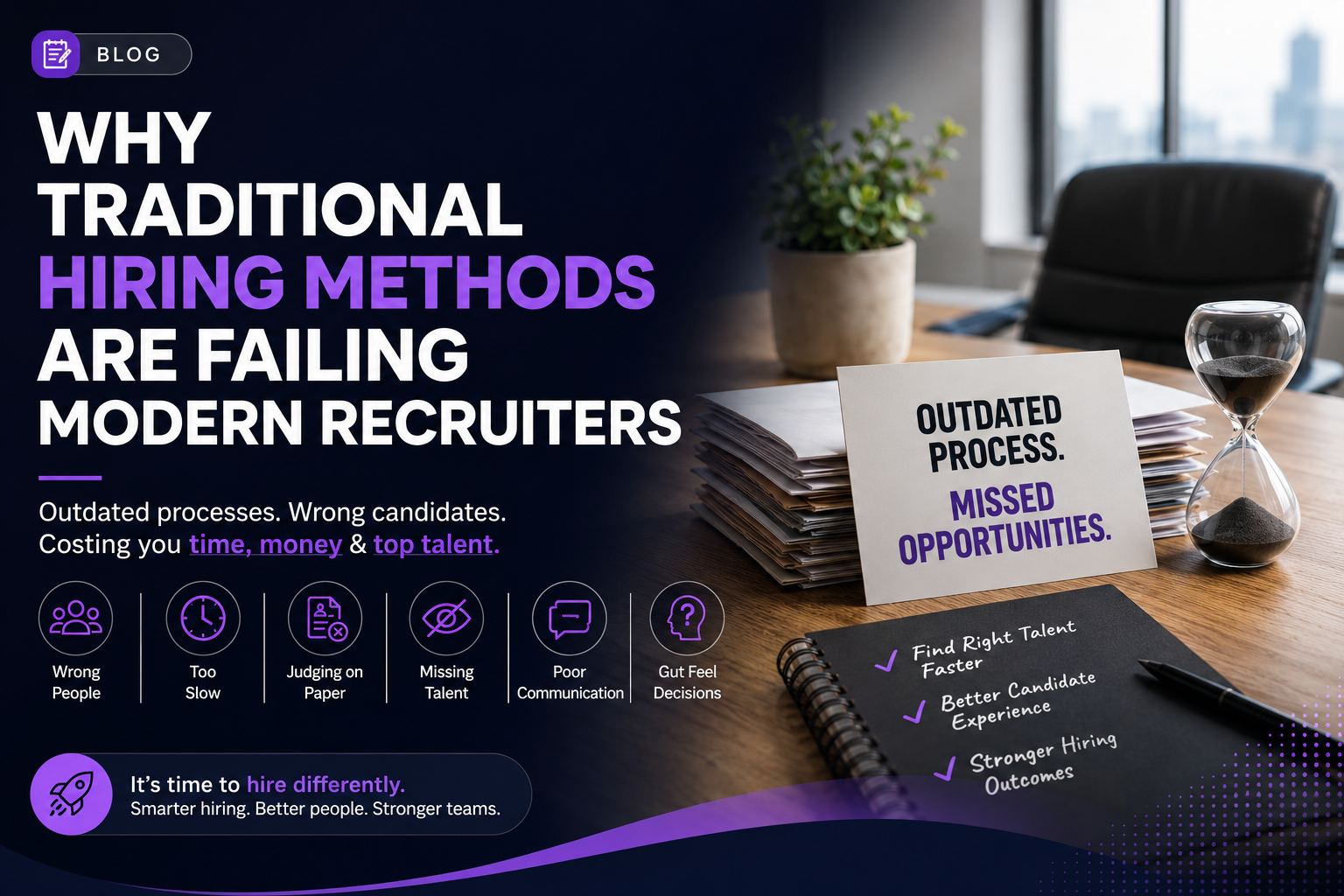
Why Traditional Hiring Methods Are Failing Modern Recruiters
Author: Sakshi | Published Date: 19 May 2026 | Published Time: 10:16 AM IST
You've posted the job. Waited two weeks. Got 200 applications.
And not one of them is quite right.
Here's the uncomfortable truth — the problem isn't the candidates. It's the process.
Traditional hiring was built for a different era. And in 2026, it's costing Australian businesses time, money, and their best talent.
What Is "Traditional Hiring" — And Why Is It Still So Common?
Traditional hiring follows a familiar pattern:
- Write a job ad and post it on Seek
- Wait for applications to come in
- Filter CVs manually
- Phone screen the shortlist
- Interview two or three candidates
- Make an offer based on gut feel
It worked — once. When talent supply exceeded demand, when candidates had fewer options, and when hiring managers had the luxury of time.
That world no longer exists.
How Big Is the Problem in 2026?
Australia's unemployment rate sits at just 4.1%. There are 339,400 advertised vacancies — and even more roles going unfilled in the hidden market.
In sectors like healthcare, construction, and technology, the competition for skilled workers is fierce. The best candidates are off the market within days — sometimes hours.
A hiring process that takes six weeks doesn't just slow you down. It hands your ideal hire to a competitor.
Which Industries Are Feeling It Most?
Healthcare & Aged Care — Very high impact. Nurses and allied health professionals are placed through agency databases before most job ads even go live. Slow processes mean empty rosters.
Construction & Trades — Very high impact. Electricians, project managers, and site supervisors are hired almost entirely through networks. By the time your ad is approved, the candidate has three offers.
Technology & IT — High impact. Software engineers and cybersecurity specialists are headhunted directly on LinkedIn. Traditional job ads reach the ones who are already unemployed — not the ones you actually want.
Finance & Accounting — High impact. Senior roles like CFOs and finance managers rarely get publicly advertised at all. If you're waiting for applicants, you're playing the wrong game.
Transport & Logistics — Moderate impact. Driver and fleet manager shortages are chronic. Companies relying on reactive advertising are perpetually understaffed.
6 Ways Traditional Hiring Is Failing You Right Now
1. Your Job Ad Attracts the Wrong People Generic job boards generate volume — not quality. A single Seek listing can attract 300+ applications, most of them irrelevant. Your recruiter spends days screening CVs instead of evaluating real candidates.
2. Your Process Is Too Slow Five-round interviews and two-week response windows made sense when candidates waited. Today, a strong candidate accepts an offer while you're still scheduling the second interview. Speed is not just efficiency — it's respect.
3. You're Judging People on Paper CV-first filtering eliminates candidates who look wrong on paper but would perform brilliantly in the role. Skills, attitude, and cultural fit rarely show up in a resume — but they're what actually determines success.
4. You're Missing the Hidden Market Up to 70% of roles in Australia are filled before they're ever advertised. If your entire strategy is posting and waiting, you're only accessing 30% of the available talent — and the most passive part of it.
5. Candidate Communication Is Broken Most hiring processes are a black hole for applicants. No updates, no feedback, no timeline. Over 60% of candidates who have a poor experience share it publicly. Every ghost is a brand damage moment.
6. Decisions Are Based on Gut Feel Unstructured interviews are one of the weakest predictors of job performance. They also allow unconscious bias to drive decisions — limiting diversity and leading to hires who seemed right but weren't.
What Recruiters Don't Tell You
Your job ad is working against you — Ads written by HR often miss what the hiring manager actually needs. The real priorities — pace, personality, team dynamics — never make it onto the page. Candidates apply for a job that doesn't quite match reality, and everyone is disappointed.
The best candidates aren't applying — Top performers are rarely on Seek. They're being approached directly, through networks and recruiters who know their value. If your only strategy is inbound applications, you're not reaching them.
Speed beats perfection — A hiring manager who responds within 24 hours almost always secures a better candidate than one who deliberates for a week. Decisiveness signals a culture worth joining.
Skills matter more than degrees now — In 2026, 85% of Australian organisations use skills-based hiring. A candidate with a strong track record and no degree will often outperform one with credentials and no results.
Your Obligations as an Employer in Australia
Every worker you hire — including visa holders — is protected under the Fair Work Act. As an employer, your obligations include:
- Paying minimum wage and applicable penalty rates
- Providing paid leave entitlements
- Maintaining safe working conditions
- Contributing to superannuation
- Following fair dismissal procedures
Getting these wrong doesn't just create legal risk — it damages the trust that makes good hiring possible in the first place.
How JobReady Placements Helps You Hire Differently
JobReady Placements works differently from a generic job board.
When you list a role with us, you're not just posting an ad and hoping. You're accessing a curated database of verified Australian candidates — across IT, admin, finance, healthcare, marketing, and more — who are actively looking and ready to move.
We help you move faster, screen smarter, and hire people who actually fit — not just people who applied first.
Post your role today at jobreadyplacements.com.au
References & Research Sources
AI and automation are increasingly used in Australian recruitment to speed up candidate screening
https://www.ibm.com/thought-leadership/institute-business-value/en-us/report/ai-in-recruitment
Skills-based hiring is becoming the standard, with practical experience prioritised over degrees
https://www.randstad.com/workforce-insights/talent-management/skills-based-hiring/
Professional networking remains a key channel for filling roles outside job boards
https://www.seek.com.au/career-advice/article/how-networking-can-help-you-find-a-job
Australia continues to face worker shortages across healthcare, technology, construction, and logistics
https://www.abs.gov.au/statistics/labour/jobs/job-vacancies-australia
Faster hiring decisions are becoming critical to securing top talent before competitors
https://www.michaelpage.com.au/advice/market-insights/hiring-advice/future-recruitment-trends-australia
#HiringInAustralia #RecruitmentFails #ModernRecruitment #AustralianJobMarket #HRStrategy #TalentAcquisition #JobReadyPlacements #HiringTips #RecruitmentAustralia #SkillsBasedHiring #HRLeaders #FutureOfWork #HiringManagers #SmartHiring #WorkInAustralia