Category: Jobseekers, General, Interview
How to Improve Resume Visibility and Get Noticed by Recruiters in Australia
By Sophie Anderson | July 1, 2026 | 10:00 AM IST
Applying for jobs is rarely the hard part. Getting a recruiter to actually stop, read, and remember your resume — that's where most students and graduates get stuck. You can send fifty applications and hear nothing back, not because your skills aren't good enough, but because your resume never gave a recruiter a reason to notice it.
Recruiters in Australia often go through dozens of applications for a single opening. Most resumes get scanned in a matter of seconds before a decision is made to move forward or move on. If your resume doesn't communicate the right things quickly, it doesn't matter how capable you actually are — it simply won't get picked up.
What Makes a Resume Visible
A visible resume is one that a recruiter, or the software they use to screen applications, can understand at a glance. It's not about design flair. It's about clarity — the right words, in the right places, describing experience that's easy to match against the job description.
If a company is hiring for an entry-level administration role, the recruiter is scanning for terms like administration, customer service, data entry, scheduling, or Microsoft Office. If those skills exist on your resume but are buried in vague sentences or missing entirely, your application can get passed over even when you're a genuine fit.
Why This Matters More for Students and Freshers
Freshers often assume they need years of experience to compete, but that's rarely what employers are actually screening for at entry level. What they want is evidence of potential — the ability to learn quickly, communicate well, and handle real responsibility. That evidence can come from internships, part-time work, academic projects, or volunteering just as easily as it can from full-time jobs.
The problem isn't a lack of relevant experience. It's that this experience is often written flatly, without context, so recruiters don't see the value in it. A resume that connects your background to the job — even an unconventional background — will always outperform one that just lists where you've been.
Match Your Resume to the Job Description
Every job ad tells you what the employer is actually looking for. Before you apply, read it closely and note the specific skills, tools, and responsibilities mentioned — then reflect that language in your resume, wherever it's genuinely true of your experience.
If a listing mentions customer service, teamwork, and Excel, and those are things you've actually done, use those exact terms in your summary or experience section rather than a synonym. This isn't about gaming a system — it's about making it effortless for a recruiter to see the match. Avoid copying the job ad wholesale; the goal is relevance, not repetition.
Keep the Format Clean
A resume doesn't need to look elaborate to work well. In most cases, simpler performs better. Heavy use of colour, icons, tables, or multi-column layouts can look appealing but often makes a resume harder to scan — and some applicant tracking systems struggle to read them correctly, which can knock your application out before a human ever sees it.
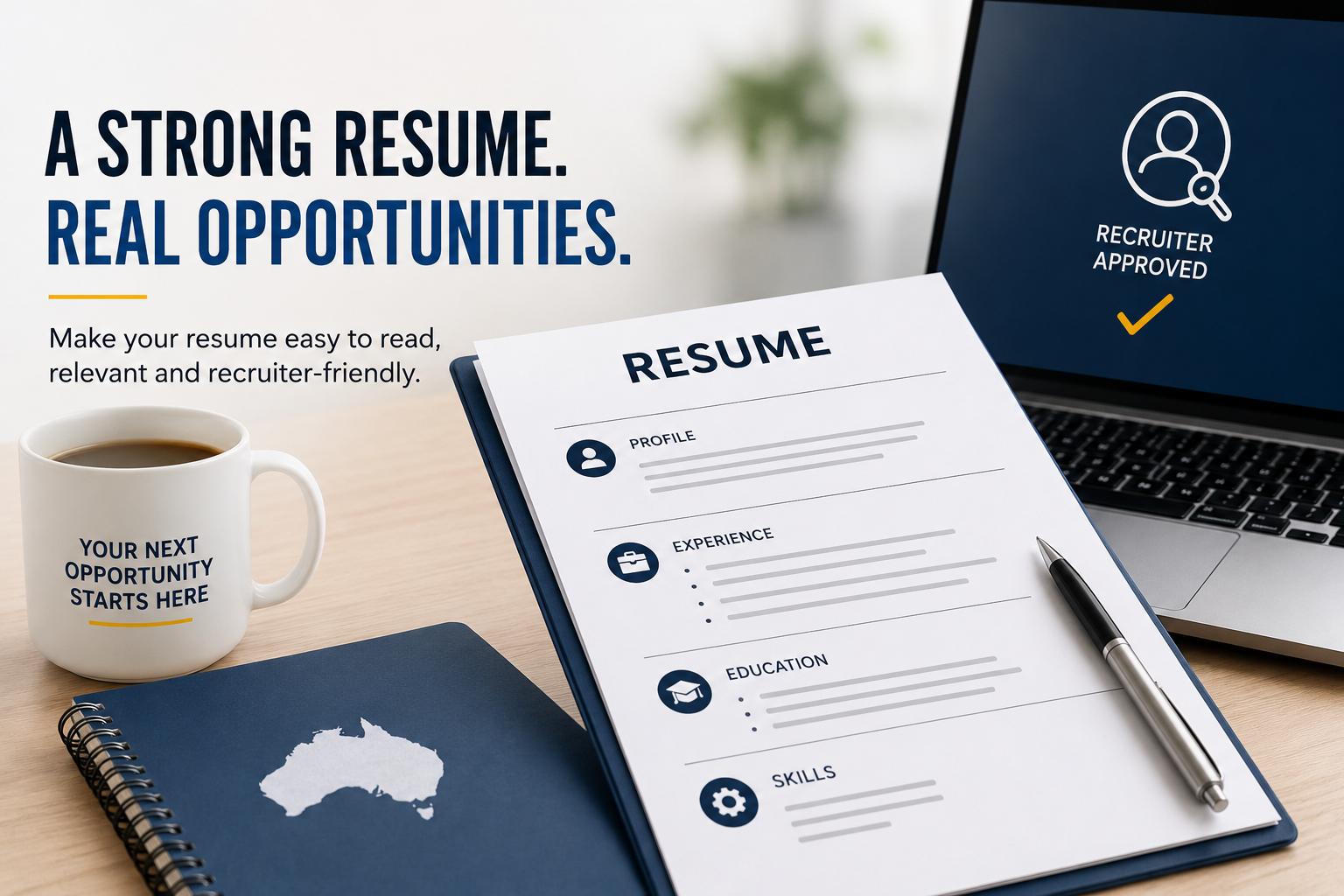
Stick to clear section headings — Career Summary, Education, Work Experience, Skills, Projects, Certifications — with consistent spacing and a simple font. Use short bullet points sparingly for specific achievements, but keep the rest of the resume in clean, direct sentences rather than defaulting to lists for everything.
Write a Summary That Actually Says Something
Your career summary sits at the top of the resume, so it's often the only part that gets read properly before a recruiter decides whether to continue. It should say who you are, what you're good at, and what you're looking for — in two to three sentences, not a paragraph.
For example, a business graduate with strong communication and administration skills, developed through academic projects and part-time customer service roles, seeking an entry-level position to apply organisational and problem-solving abilities in a professional setting.
Keep it specific to the role you're applying for rather than reusing one generic version everywhere.
Focus on Achievements, Not Just Duties
One of the most common resume mistakes is listing responsibilities without showing outcomes. Writing "responsible for customer service" tells a recruiter almost nothing. Writing that you assisted customers with product queries and supported smooth store operations during peak hours tells them exactly what you did and how well you handled it.
The same applies to academic or volunteer work. Instead of saying you "worked on a college project," describe how you completed a group marketing project analysing customer behaviour and presented recommendations to improve engagement. This small shift — from duty to outcome — makes a resume feel far more credible.
Keep It Current and Tailored
A resume written once and reused for months tends to lose relevance fast. Update it whenever you finish a course, internship, or project, and adjust it slightly for each type of role you're applying for. If you're applying for administration jobs, lead with organisation and communication skills. If you're applying for marketing roles, lead with content, research, and campaign experience.
You don't need a completely different resume for every application — just make sure the most relevant information is near the top, and the language matches what that particular employer is looking for.
Common Mistakes That Cost Interviews
A few small issues can undo an otherwise strong resume: spelling errors, an outdated contact number, an unprofessional email address, unexplained employment gaps, or a resume that runs to three or four pages. For students and early-career applicants, one to two pages is almost always enough. Keep your contact details — name, phone, email, city, and LinkedIn — clearly visible near the top, and use a professional email address built around your name rather than a nickname or numbers.
Don't Forget LinkedIn
Your resume isn't the only thing recruiters check. A LinkedIn profile with a clear photo, an updated headline, and visible project or internship experience adds credibility and often gets checked before or after a resume is reviewed. A headline that reads "Business Graduate | Customer Service | Administration Support" tells a recruiter more in five seconds than simply "Student" ever will.
Final Thoughts
A resume that gets noticed isn't necessarily the most polished or the most detailed — it's the one that makes a recruiter's job easy. Clear structure, relevant keywords, and achievement-focused writing consistently outperform generic, duty-based resumes, regardless of how much experience the candidate has.
You don't need a long work history to stand out. You need a resume that's honest, specific, and clearly aimed at the role in front of you. Update it often, tailor it to each application, and let your LinkedIn profile back it up — and the recruiter calls will follow. “Students can also explore opportunities on JobReady Placements to start applying for suitable roles.”
“For support with jobs, internships or applications, contact the team.”
Sources & References
Job Jumpstart — Tailoring your resume to match employer keywords and job requirements.
https://www.jobjumpstart.gov.au/article/four-steps-tailoring-your-resume
Youth Central Victoria — Resume writing guidance for students, young job seekers and recruitment software keywords.
https://www.youthcentral.vic.gov.au/jobs/resumes-and-cover-letters/how-write-resume
SEEK Australia — Resume format, structure, skills and experience for Australian job applications.
https://au.seek.com/career-advice/article/resume-cv
SEEK Australia — How to highlight achievements instead of only listing duties in a resume.
https://au.seek.com/career-advice/article/how-to-talk-about-achievements-in-your-resume
Hays Australia — Professional resume writing tips and CV structure for Australian job seekers.
https://www.hays.com.au/career-advice/resumes-cover-letters/how-to-write-a-resume
LinkedIn Help — How job seekers can show recruiters they are open to work.
https://www.linkedin.com/help/linkedin/answer/a507508/let-recruiters-know-you-re-open-to-work