Category: Jobseekers, Employers, Interview
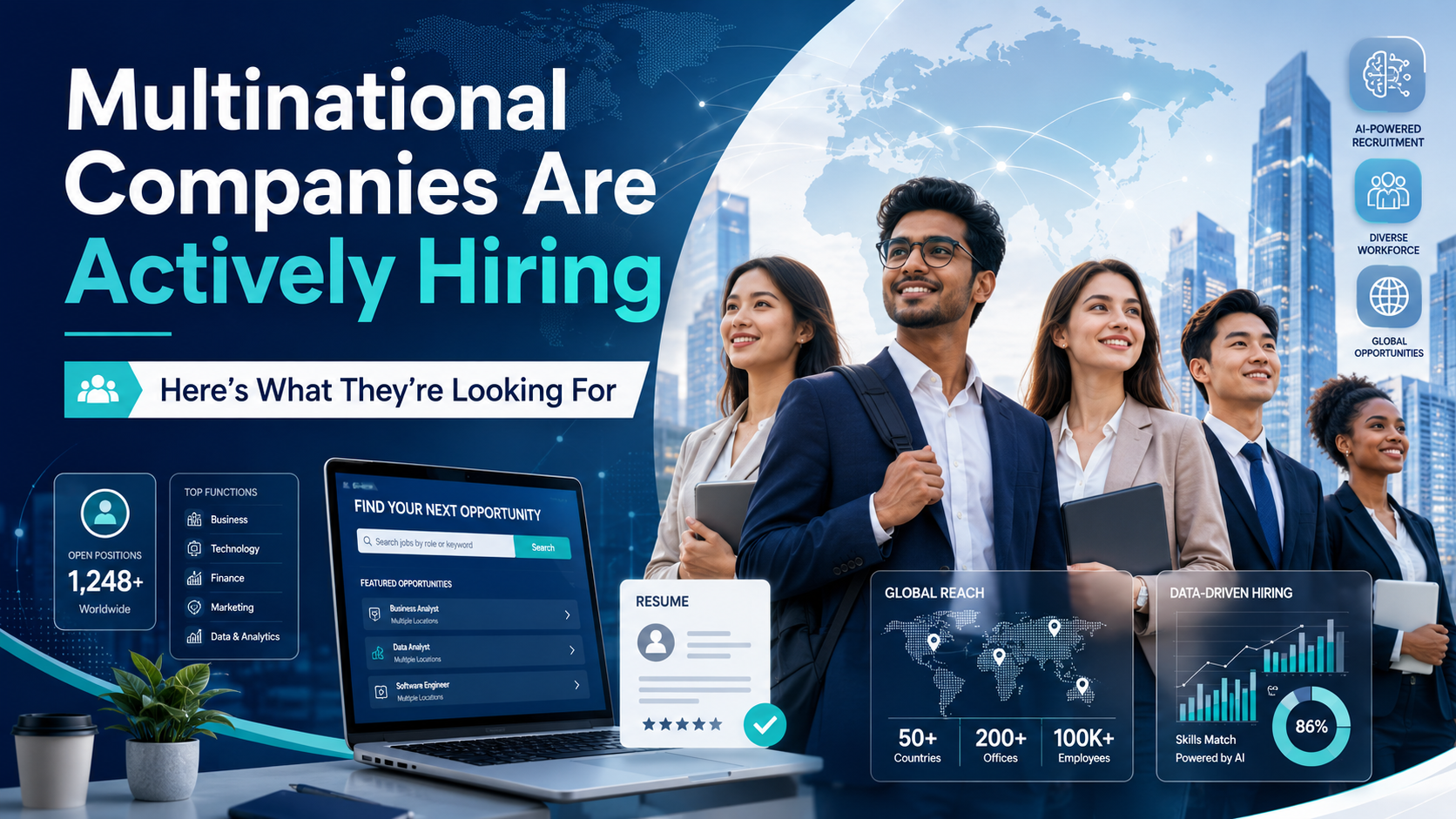
Multinational Companies Are Actively Hiring — Here's What They're Looking For
Author: Anthony Swan
Published Date: 10 June 2026
Published Time: 10:15 AM IST
If you are a student or fresh graduate wondering whether big global companies actually hire people like you — the answer in 2026 is a clear yes. Multinational giants are running active hiring programs right now, and many of them are specifically looking for entry-level talent to bring in fresh perspectives. The competition is real, but so is the opportunity.
The good news is that multinationals are not just looking for perfect candidates with years of experience. They want graduates who are job-ready, adaptable, and eager to learn. If you know what they are looking for — and you prepare accordingly — getting your foot in the door is absolutely achievable.
Here is everything you need to know about who is hiring, what they want, and how to position yourself to get noticed.
Why 2026 Is a Big Year for Graduate Hiring
The job market has shifted in a positive direction. After a period of slowdown, multinational companies are back in hiring mode — and fresh graduates are a key part of the plan.
- Graduate job postings have rebounded in early 2026 after softening in 2025
- Companies are building new teams around AI, data, and digital operations — and they want fresh talent for these roles
- Structured graduate programs are growing at companies like Amazon, Deloitte, and Accenture
- Internship-to-full-time conversion is becoming one of the biggest entry pathways into large firms
- Gen Z graduates are now one of the most sought-after talent pools globally, with Google, Microsoft, and Amazon ranking as top dream employers for students in 2026
The message is simple: the window is open. The question is whether you are ready to walk through it.
Top Multinational Companies Hiring Fresh Graduates Right Now
1. Apple
Apple is actively hiring across technology and AI/ML roles. They are looking for graduates who can problem-solve, write clean code, and work in fast-paced agile environments. Apple describes itself as a place where extraordinary people gather to do their best work — and they mean it when they say they want people who think differently.
Roles currently available:
- Software Engineer (Entry Level)
- AIML Data Operations Analyst
- Technical Support Specialist
- Sales and Business Development Associate
What Apple looks for in graduates:
- Degree in Computer Science, Computer Engineering, IT, or related field
- Programming skills in Python, Java, C++, or SQL
- Internship or personal project experience is a strong advantage
- Strong communication skills and the ability to collaborate across teams
- Participation in Agile workflows and a genuine curiosity for new technologies
2. Amazon
Amazon runs one of the most structured graduate programs in the world. Their 2026 and 2027 graduate and internship intakes are currently open across operations, technology, and business roles. Amazon is known for its culture of ownership — they want graduates who think like leaders, not just employees.
Roles currently available:
- Graduate Area Manager — Operations
- Software Development Engineer
- Safety Specialist Intern
- Network Development Engineer
- Campus Recruiter (for those interested in HR and talent)
What Amazon looks for in graduates:
- Strong analytical thinking and problem-solving ability
- Leadership potential — even at entry level, Amazon expects you to take ownership
- Comfort working in high-pressure, fast-moving environments
- Any degree for operations roles; tech or engineering degree for software roles
- Ability to back decisions with data and communicate clearly
3. Google
Google remains one of the most desirable employers for graduates globally. They hire across engineering, data analytics, marketing, and product roles. Google is known for being selective, but they are also consistent in what they look for — and it is learnable.
What Google looks for in graduates:
- Ability to work with data and think systematically
- Strong academic results combined with real-world projects or internships
- Technical skills in SQL, Python, and cloud platforms
- Creative problem-solving and a collaborative approach
- Evidence of self-directed learning beyond the classroom
4. Deloitte
Deloitte is one of the biggest graduate recruiters in the professional services world. Their entry-level analyst and associate programs are well-structured, well-paid, and come with strong mentorship. If you are interested in consulting, finance, cyber security, or data — Deloitte is one of the best places to start.
Roles currently available:
- Analyst — Government and Public Services
- Cyber Security Associate
- Data Analytics Graduate
- Finance and Consulting Entry Level Associate
What Deloitte looks for in graduates:
- Degree in finance, IT, law, commerce, business, or engineering
- Financial modelling knowledge is a clear advantage
- Strong written and verbal communication skills
- Attention to detail and ability to manage multiple tasks under deadlines
- A genuine interest in the industry sector you are applying to
5. Microsoft, IBM, and Accenture
These three companies run ongoing and well-funded graduate hiring programs across technology, consulting, and digital transformation. They are also known for being relatively accessible to graduates from a wide range of degree backgrounds.
- Microsoft offers the Aspire Program — a structured 1+ year learning and development journey designed specifically for new graduates entering the company from undergraduate, masters, or MBA programs
- IBM actively hires at entry level for data, cloud, and AI roles and is known for investing heavily in graduate training
- Accenture runs structured intake programs across software development, SAP, data analytics, and consulting — and specifically looks for graduates who want to work across multiple industries
What Skills Are Multinational Companies Actually Looking For?
No matter which company you are targeting, the skills that keep appearing across all multinational hiring processes in 2026 are consistent. Here is a breakdown of exactly what they want:
Technical Skills:
- SQL and Excel at an intermediate level minimum — even non-technical roles are asking for this
- Python basics — the demand for basic coding literacy has expanded well beyond IT roles
- Familiarity with tools like Figma, JIRA, Notion, or GitHub
- Understanding of AI tools and cloud platforms is a growing requirement across all industries
- Data literacy — the ability to read, interpret, and present data in a clear way
Soft Skills:
- Cross-cultural communication — multinationals operate across countries and time zones, and they need people who can work with diverse teams
- Adaptability and willingness to learn quickly in fast-changing environments
- Strategic thinking — the ability to see the bigger picture, not just complete tasks
- Strong written and verbal communication in English
- Time management and the ability to handle multiple priorities at once
What sets candidates apart from the crowd:
- Self-directed learning — an online certification from Coursera, LinkedIn Learning, or Google Career Certificates shows initiative
- A personal project, GitHub portfolio, or case study that demonstrates real skills
- Internship or part-time work experience, even if it is short-term or in a related field
- Knowing the company's products, values, and recent news and being able to reference them confidently in your application and interview
How to Actually Get Hired at a Multinational Company
Getting shortlisted at a big company is not about luck. It is about being prepared before the application window even opens.
Step 1 — Apply directly on company careers pages Most graduate roles at multinationals are posted on official careers pages before they appear on job boards. Set up job alerts directly on company websites — do not rely only on Seek or LinkedIn to find them.
Step 2 — Tailor your resume for every single role Do not send the same resume to every company. Read the job description carefully, match your skills and experience to what they are asking for, and use the same language and keywords they use. In 2026, many companies use Applicant Tracking Systems (ATS) to screen resumes before a human ever sees them — tailoring your resume to the job description helps you pass that first filter.
Step 3 — Build the missing skills before you apply If a job asks for a skill you do not have yet, go and get it. A short online course with a certificate shows that you are proactive and serious. Do not wait until you feel 100 percent ready — start learning and start applying at the same time.
Step 4 — Prioritise internship and vacation programs Multinationals are increasingly using internships as their primary hiring pipeline. Many of the graduate roles at companies like Amazon and Accenture are filled by people who interned there first. If a full-time role feels out of reach right now, start with an internship — it is often the fastest path to a permanent offer.
Step 5 — Prepare seriously for the interview Research the company's recent news, products, and values before every interview. Know their mission statement. Be ready to talk about why you want to work there specifically — not just why you want a job. Hiring managers at multinational companies make decisions quickly, and candidates who clearly understand the company always stand out.
Step 6 — Follow up after applying Many graduates apply and then wait passively. A professional follow-up email after submitting your application — or after an interview — shows genuine interest and keeps your name in front of the recruiter. Keep it short, polite, and specific to the role.
Common Mistakes Graduates Make When Applying to Multinationals
Even strong candidates miss out because of avoidable errors. Watch out for these:
- Sending a generic resume without tailoring it to the job description
- Applying only through job boards and missing direct career page postings
- Listing outdated skills like "Microsoft Word" or "basic computer skills" — these add no value in 2026
- Not preparing for behavioural interview questions like "Tell me about a time you solved a problem under pressure"
- Underestimating the value of internship experience when applying for graduate roles
- Waiting until after graduation to start applying — many intake programs open 6 to 9 months before the start date
Final Thoughts
Multinational companies are not just hiring — they are actively looking for graduates who are job-ready, adaptable, and eager to grow. The skills they want in 2026 are learnable. The roles are real and open right now. The only thing standing between you and your first job at a global company is preparation and the confidence to put yourself forward.
Start building your skills today, apply directly and early, and back yourself to compete with the best.
Looking for more tips on landing your first job at a top company? Explore our latest career guides at JobReadyPlacements.com.au
Sources and References
Apple Careers – Students and Internships
https://www.apple.com/careers/in/work-at-apple/students.html
Amazon University Talent Acquisition
https://www.amazon.jobs/content/en/career-programs/university
Google Careers – Internships
https://www.google.com/about/careers/applications/internships
Microsoft Careers – Recent Graduate Opportunities
https://careers.microsoft.com/v2/global/en/recentgraduate
Deloitte Careers – Early Careers
https://www.deloitte.com/ui/en/careers/careers.html
Accenture Careers – Internships and Student Programs
https://www.accenture.com/in-en/careers/life-at-accenture/internships-students
#MultinationalCompanies #GraduateJobs #EntryLevelJobs #FreshGraduateJobs #CareerOpportunities #JobReadySkills #InternshipOpportunities #GlobalCareers #HiringTrends #CareerPreparation #StudentCareers #FutureOfWork