Category: Jobseekers, Employers, Interview
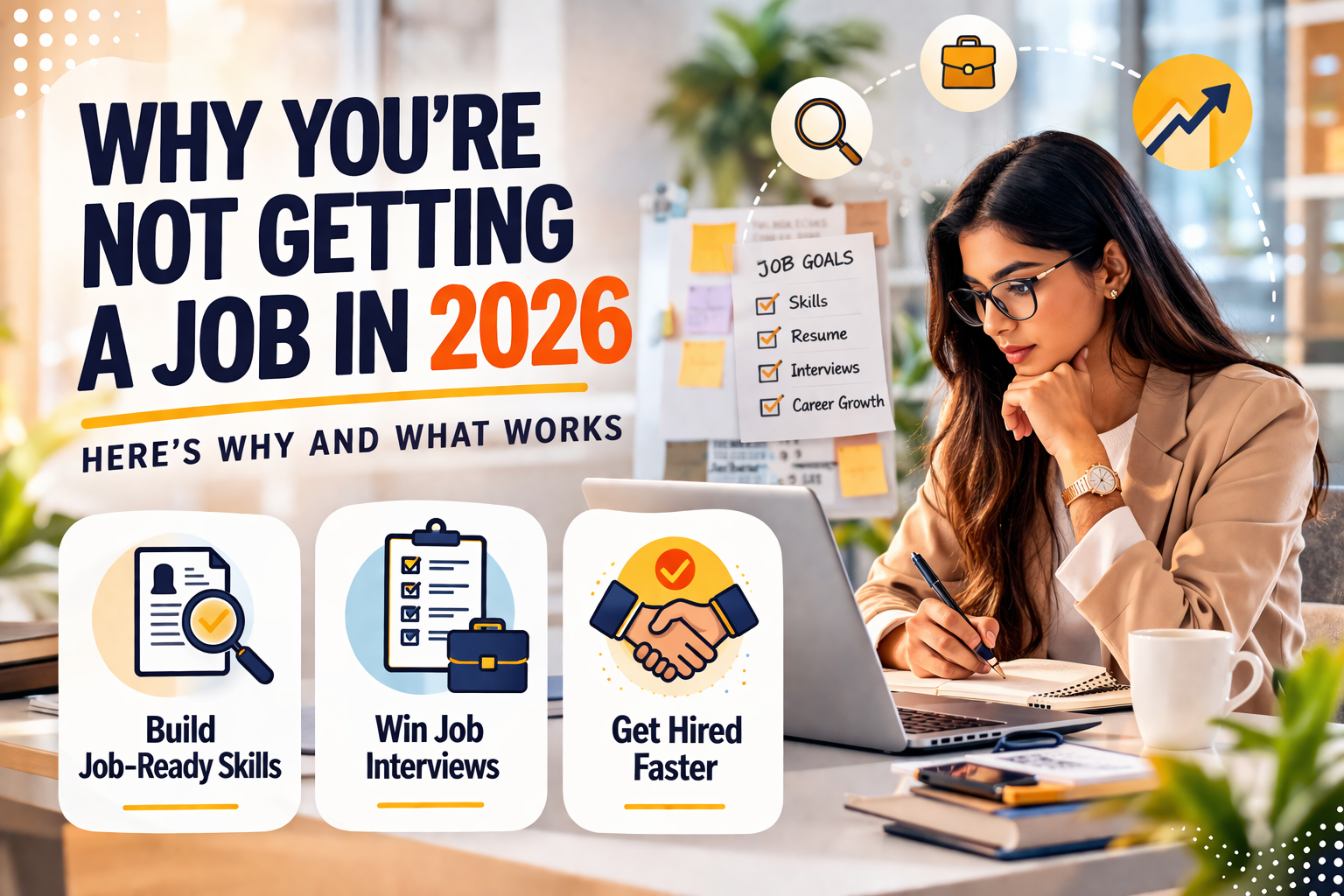
Why You’re Not Getting a Job in 2026 – And What Actually Works Today
If you’ve been applying for jobs and getting no response, the problem is not just competition — it’s how hiring actually works in 2026.
Companies are not hiring the way they used to. They are reducing hiring risk, cutting training time, and choosing candidates who can start delivering results immediately. At the same time, more people are applying for the same roles, including experienced candidates.
This is why many freshers and job seekers feel stuck — not because jobs don’t exist, but because expectations have changed.
Problem: What Has Actually Changed in Hiring
Hiring today is driven by efficiency, not volume.
Here’s what is happening in real terms:
- Companies receive hundreds of applications for one role
- They use ATS systems to filter resumes automatically
- They prefer candidates who require minimal training
- Entry-level roles are reduced because they are expensive to train
This creates a gap:
Candidates are applying more, but getting fewer results
Evidence: What Recruiters Actually Look At
Recruiters are not spending time reading every resume.
They filter based on:
- Skills mentioned clearly (Excel, tools, communication)
- Proof of work (projects, internships, portfolio)
- Resume structure (ATS-friendly format)
- Relevance to the job role
If your profile does not match these filters,
you get rejected before anyone even sees your application
Impact: Who Is Struggling the Most
Most affected people:
- Fresh graduates
- Candidates without internships
- People using generic resumes
- Job seekers applying randomly
Why they struggle:
- No practical experience
- No clear skill positioning
- No proof that they can actually do the job
Employers don’t reject potential —
they reject uncertainty
What Employers Actually Want
Employers are looking for low-risk hires
That means:
- Someone who knows Excel or Google Sheets
- Someone who can write proper emails and communicate clearly
- Someone who has done at least 1–2 real projects
- Someone who understands basic tools (CRM, reporting, dashboards)
- Someone who can start working with minimal guidance
This is what “job-ready” actually means —
not certificates, but capability
Why Most Job Platforms Don’t Help
Most job platforms only do one thing:
Show job listings
They don’t tell you:
- Why you are getting rejected
- What you are missing
- How to fix your profile
That’s why people keep applying but don’t get results
Solution: How Job Ready Placements Actually Helps
Job Ready Placements is built differently — it focuses on getting you hired, not just getting you to apply
What it actually does:
1. Verified Job Listings
Only verified employers can post jobs, reducing fake or low-quality listings
2. Real Opportunities (Jobs + Internships)
You can apply to part-time, full-time, and internship roles based on your level
3. Profile-Based Hiring
Employers can directly contact you if your profile matches their requirements
4. Skill + Career Support
The platform focuses on guidance, training, and practical preparation — not just applications
Result:
Better chances of getting shortlisted
Faster responses
More relevant job matches
Action Plan: What Actually Works in 2026
1. Stop Applying Without Strategy
More applications ≠ more results
2. Build Real Skills
Start with:
- Excel / Google Sheets
- Communication
- Basic tools used in jobs
3. Create Proof of Work
- Projects
- Case studies
- Portfolio
4. Get Experience
- Internships
- Freelance work
- Practice-based work
5. Fix Your Resume
- ATS-friendly format
- Results-based points
- No generic content
6. Use the Right Platform
Use platforms like Job Ready Placements that actually improve your chances — not just show jobs
Conclusion
Getting a job in 2026 is not about luck — it’s about positioning.
Companies are not rejecting candidates randomly.
They are selecting candidates who reduce their risk.
If your profile shows skill + proof + clarity → you get hired
If it shows only qualification → you get ignored
Source
- https://www.weforum.org/stories/2023/05/future-of-jobs-skills-demand/
- https://www.linkedin.com/pulse/top-skills-you-need-get-hired-2026-linkedin-news/
- https://hbr.org/2024/01/how-ai-is-changing-hiring
- https://www.mckinsey.com/capabilities/people-and-organizational-performance/our-insights/future-of-work-after-covid-19
#jobsearch2026 #freshersjobs #jobreadyskills #careeradvice #gethiredfast #entryleveljobs #resumetips #jobmarket2026 #skillsforjobs #internshipsmatter #jobseekers #careerhelp #hiringtrends #jobtips #careergrowth